

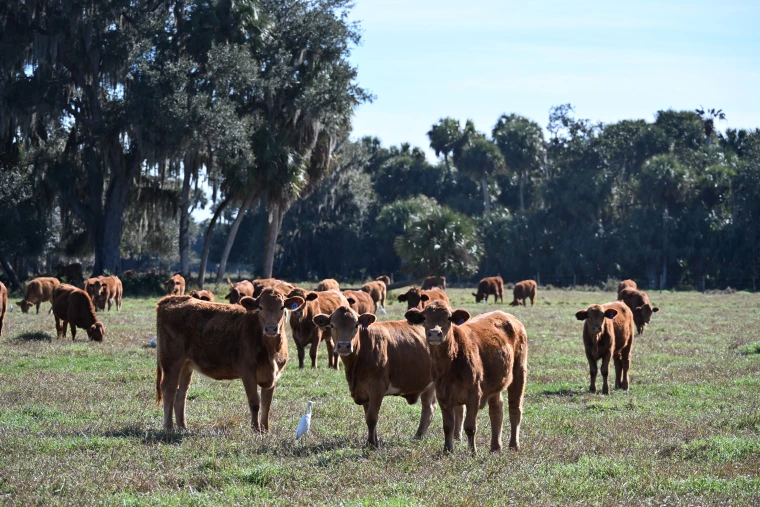
The Adams Ranch was the first to develop a breed of cattle in Florida for Florida, the Braford breed. This Brahman - Hereford cross could handle heat and insects and still produce desirable meat. In this interview, Mike Adams describes agricultural history in this subtropical wilderness of grass and how his family has shaped and continues to shape the beef industry in the Deep South, including innovative meat marketing and continued cattle genetics refinement. The Adams Ranch was the Environmental Stewardship Award winner in 1991 for the National Cattlemen's Beef Association Region 2.
The Art of Range Podcast is supported by the Idaho Rangeland Resources Commission; Vence, a subsidiary of Merck Animal Health; and the Western Extension Risk Management Education Center.
Music by Lewis Roise.
Transcript
[ Music ]
[Tip Hudson:] Welcome to "The Art of Range," a podcast focused on rangelands and the people who manage them. I'm your host, Tip Hudson, Range and Livestock Specialist with Washington State University Extension. The goal of this podcast is education and conservation through conversation. Find us online at artofrange.com.
[ Music ]
All right. Welcome back to "The Art of Range." My guest today is Mike Adams. He is the proprietor, I suppose you might say, at the Adams Ranch, one of the larger cow-calf operations in Florida, and I'm thrilled to be visiting with Mike in person at their place north of Okeechobee, northeast of Okeechobee. Mike, welcome.
[Mike Adams:] Welcome. I'm glad that you could come visit.
[Tip Hudson:] Yeah, this is a really beautiful spot. I was here in 2004 on a tour, I think, with the National Association of County Agricultural Agents, and it was the first time that I had been in this part of Florida, having grown up in The Ozarks, and I was really captivated by the beauty of the country down here. It really is unique. And I have several photographs from your ranch that I think it was one of the first times that I realized that my favorite color is actually a color combination, but it's the color of Braford red on grass green, and there's just nothing quite like it.
[Mike Adams:] Well, we can't argue with you there. That's always been a passion for us is the red cattle, red horses, red dogs [laughter], and green grass.
[Tip Hudson:] Yeah. Yeah, a lot of people don't know that some of the biggest cow-calf operations in the country are in this part of Florida, and there's probably some people that don't hear -- don't even realize that there's a lot of cattle in Florida, period. But can you describe a little bit of the history of your operation and the history of cattle in South Florida in general?
[Mike Adams:] Yeah, our operation started in 1937 with my grandfather acquiring the land out this way. And at the time, you know, we were coming out of the Depression. And so, there were some interesting opportunities to buy land, and at the time, it was open range. And so, there was not a lot of interest in buying cattle land because, basically, it was all free. If you had cattle, you could, you know --
[Tip Hudson:] Go use it.
[Mike Adams:] -- you could use it.
[Tip Hudson:] Wow.
[Mike Adams:] And at the same time, you know, it was probably overgrazed at the time because, you know, you had different cattlemen and cattle ran together, so there was really no particularly control of different areas. But my grandfather, at that time, recognized that, you know, Florida was changing. And so, he was the first to actually fence this property.
[Tip Hudson:] Wow.
[Mike Adams:] And so, it was, of course, very rural.
[Tip Hudson:] Yeah.
[Mike Adams:] Our main access road you came in on was, you know, barely a road at the time, so it was seeing a lot of change over the years, and --
[Tip Hudson:] And was the coast at that time fairly urbanized, and how far away are we?
[Mike Adams:] Right. We're, you know, about 15-17 miles from, kind of, center of Fort Pierce.
[Tip Hudson:] Not very far.
[Mike Adams:] It's not that far. But it lays up on the St. Lucie River.
[Tip Hudson:] Yeah.
[Mike Adams:] And it had, you know, some access to the ocean right here, as well. So, you know, that was kind of the impetus for Fort Pierce to settle in the, you know, kind of, late 1800s. And, you know, of course, it was developed, you know, primarily when the railroad kind of came through. It went from more of a fishing village to, you know, really opening up Florida when they put the railroad all the way down to the Keys.
[Tip Hudson:] Yeah. What kind of cattle were they running at that time?
[Mike Adams:] At that time, it was Florida scrub cattle is what we called them, but they were Spanish descended from cattle that were, you know, brought in and dropped off at, you know, St. Augustine by the Spaniards. And, you know, they developed, you know, over that time to be acclimated for the environment, so they were small cattle.
[Tip Hudson:] Right.
[Mike Adams:] Their horns were kind of, you know, small, spiked, you know, curved up. And so, you know, they could fend for themselves very well.
[Tip Hudson:] Right, but not very productive. I think I read somewhere conception rates were like 25% with those animals.
[Mike Adams:] I would think they were -- had to be better than that.
[Tip Hudson:] Okay.
[Mike Adams:] I think they would get phased out altogether.
[Tip Hudson:] Yeah.
[Mike Adams:] You know, but I'm sure they, you know, had their limits as far as, you know, what they, you know, survived with.
[Tip Hudson:] Yeah.
[Mike Adams:] But, you know, and, of course, out west, they became the Texas Longhorns, and just a different environment showed that, you know, how they changed over the years. Our cattle probably got smaller. Of course, the western cattle got larger.
[Tip Hudson:] So how did you respond to that? You guys are well known for having developed the Braford breed. I'm not a geneticist, so I'm not even sure. How do you go from running terminal crosses that result in an animal that fits your environment to creating a breed out of that?
[Mike Adams:] You know, we started basically with -- my grandfather started with Cracker cattle, and I'll show you a picture or two of some of those, but, you know, he realized that Brahman cattle did well. And so, essentially, he bred those to some Brahman bulls until they basically became, you know, grade Brahman-type cattle. And that went on until, you know, from the '30s into the late '40s. In the late '40s, they introduced -- he and my father introduced Hereford cattle on top of those, and working with the University of Florida, they started with a rotational crisscross breeding system to kind of breed them up, come up with an animal that was a little more, you know, friendly as far as the cattle market was concerned. They had less ear, did not carry the Brahman hump, and so, you weren't really penalized on carcass characteristics. And so, you know, eventually he got to roughly, you know, 5/8, 3/8 type cross animal that kind of had those characteristics, the straight back; still had the, you know, the Hereford thickness.
[Tip Hudson:] Yeah.
[Mike Adams:] Had a little more dewlap, so they were heat tolerant and pretty adapted to Florida. And so, he's intermating those, and by 1969, you know, the USDA recognized this herd as the Braford breed.
[Tip Hudson:] Wow.
[Mike Adams:] So it was, you know, really quite an interesting thing because that was really the first breed that was, you know, established in Florida for Florida. But, of course, our other ranchers, you know, have, you know, crossbred, you know, all through the, you know, your Brangus and other things, but really never set on a, kind of a, particular animal type to be recognized as a breed so much here until, you know, I think in Mississippi or so they came up with the Brangus. But anyway, it was just, you know -- just kind of a drive to find cattle that did well here, reproduced well here with a lot of input, and, you know, they just fit the bill at the time.
[Tip Hudson:] So today, you're a cow-calf operation as well as a seed stock producer?
[Mike Adams:] That's -- we kind of are in every phase of the cattle industry now. You know, we do sell seed stock and we sell purebred Brafords and replacement heifers. But, you know, we still had a focus as to where we need to be to meet the needs of the American beef industry. So, you know, in the 1990s we introduced Red Angus and Gelbvieh breeding to our -- on top of our Brafords. And then, we were intermating those and we've come up with what we call the A Beef Composite. So they're basically half Braford, quarter Red Angus, and a quarter Gelbvieh. And these cattle, you know, grade well and still perform well. They're a little bit earlier maturing than even our Brafords are. So, you know, we get a, you know, probably an extra calf because they're a little more fertile in their lifetime and tend to be, maybe, a little bit bigger than our Brafords, but they still perform well here.
[Tip Hudson:] I was surprised, even though I knew a little bit about Florida cattle, at the size, the scale of the cow-calf industry here. Can you talk a little bit about the history of that?
[Mike Adams:] You know, historically, you know, the cattle that were Cracker cows that were raised here, a lot of them were, you know, of course, they were sold in the Civil War, which helped develop the cattle market back in the late 1800s. Trade with Cuba, a lot of our cattle went to, you know, the West Coast and were transported by the Lykes family down to Cuba to supply that market. And, of course, your local beef were, you know, utilized up and down the coast in Orlando and a few other, you know, more population centers. So, you know, the cattle that were -- a lot of the cattle that were raised here were consumed here. You know, that kind of -- and there were still, you know, the center part of the state was, you know, a large expanse and a lot of grasslands, so it was well-suited for a cow-calf type operation. After World War II, you know, the advent of the feedlots and kind of that part of the industry and finished cattle certainly changed. Cow cattle were marketed here, so your cow-calf producers, we were just strictly cow-calf. You know, we'd raise them up till, you know, 450 to 550, load them on a truck, and we were done with them.
[Tip Hudson:] And were those mostly fall calvers at the time?
[Mike Adams:] Right.
[Tip Hudson:] Okay.
[Mike Adams:] And so -- and they went out to Texas and, you know, Kansas --
[Tip Hudson:] And fed out.
[Mike Adams:] -- and fed out. So, you know, that was a huge change in, you know, the market here. So what processing plants we had here pretty well went away. So you kind of fast forward, we still, you know, tried to focus, keep a focus on, the end user. So, you know, that's why we kind of got into the, you know, what we call the A Beef.
[Tip Hudson:] Yeah.
[Mike Adams:] And in doing that, we had the opportunity back in the, you know, early -- you know, we did some work to kind of figure out how our cattle graded. You know, we retained some ownership out in some of western Kirkland via our yards, and in Decatur, to get some idea of the carcass characteristics that we had and felt like, you know, they were good. And, you know, we just kind of had the vision that, you know, there's -- or, you know, my dad had a vision that we could, you know, raise our cattle, have them processed here, and if we can grow them out here. So --and, of course, a lot of that was not -- that infrastructure wasn't here. There were really no feed lots or anything. Anyway, we got to working with Don Quincey up in Chiefland, Florida, and he put together -- you know, he had grown out some livestock market calves and he'd grow them out and sell them. And he said, well, you know, I can grow them out. We can finish them here and be close to what they do out in the Midwest, and with high corn silage and different things. So, you know, we fed a few out, and, kind of, about 2015 or so, you know, we were looking at possibly trying to sell to Publix and, you know --
[Tip Hudson:] Your own beef.
[Mike Adams:] Our own beef --
[Tip Hudson:] Yeah.
[Mike Adams:] -- and our own branded beef. And we talked to Publix and they said, well, you know, we would love to have a local product, you know, we could claim, and -- but, you know, we could take some of your steaks. And if you, you know, developed a premium, a following, and you could get a premium for your product, you know, we could, you know -- but we would just take your steaks. You know, we didn't need any more ground beef or anything else, and that just was just a non-starter for us. It just couldn't work. And -- but we were introduced to Whole Foods and, you know, we got -- we met with them and, you know, they looked at our program. And I said, you know, we've been a, you know, non-antibiotic, you know, outfit. We've always felt that cattle need to, you know, be healthy enough to be raised without antibiotics. So we didn't use antibiotics and we kind of, you know, didn't use any steroids because we heard, you know, that affected carcass characteristics or could some. So, you know, we stopped using those, you know, some years before then. And they said, well, that's great because that fits right into our Step 4 Program. And so, and, you know, they really committed up front that we could pay a premium, you know, for your beef. And they worked out that, you know, we could do just a price on hot carcass weight. So, you know, that was terrific.
[Tip Hudson:] Yeah.
[Mike Adams:] And so, there's still a lot we don't know about the cattle industry, but we're still learning. And, you know, we thought we knew a little bit. But, you know, as you go into the feedlot from a cow-calf operation, that's a whole different world.
[Tip Hudson:] Yeah.
[Mike Adams:] And then, you go through processing and how many cuts you cut out of something and then, you know, and then to retail. That's a whole different realm.
[Tip Hudson:] Yeah.
[Mike Adams:] So right now, you know, we do carry, you know, our commercial beef all the way through retained ownership. A big chunk of it goes to Whole Foods and some of it we're selling direct to retail.
[Tip Hudson:] Wow. That's a major undertaking.
[Mike Adams:] You know, it is.
[Tip Hudson:] It's one of the things people often flirt with because they think they might be able to make a little bit more money that way, but that's a whole another set of skills to try to mess with.
[Mike Adams:] It really is. And, you know, they say, well, you know, it's kind of like Whole Foods. They were willing to step up and pay a premium, and for us to even sell wholesale is, you know, it really is a tough proposition. You know, you're competing against feedlots that, you know, feed a couple hundred thousand heads. You know, their costs are so low. Your packers, you know, their margins are so tied up there. You know, so we do have one, you know, major processor here that we utilize, and that's Fort McCoy Meat Products.
[Tip Hudson:] I was going to ask where you have them processed.
[Mike Adams:] And there was a gentleman from Canada that had the vision of taking grass-fed cattle all the way through. And so, he bought 100,000 acres or so and set it up and built a brand-new processing facility up at Fort McCoy, Florida, which wasn't too far from Chiefland. And so, you know, we've been able to utilize that facility and along with, you know, what cattle that he produced. And it's still, you know -- but you still have to pay a pretty good, hefty fee for that. You know, your Western packers and things have gotten that so narrow that, you know? And so anyway, that's a hurdle that we have to overcome.
[Tip Hudson:] Yeah. What's the kind of -- the status of the cow-calf industry in this part of Florida today?
[Mike Adams:] Yeah, today --
[Tip Hudson:] There's a lot of cows around.
[Mike Adams:] Today is great. You know, we've never, you know, in my lifetime, we've never had cattle prices where they are now.
[Tip Hudson:] Yeah.
[Mike Adams:] And we've had, you know, off and on over the last, you know, 40 years of, you know, my part of the ranch. You know, we've had good years, but probably nothing at this level.
[Tip Hudson:] It seems like that can be a little bit positive and negative; negative in the sense that if somebody is looking to get out, the time to get out is when prices are high. On the other side, you know, it's maybe a good time for young people to expand a little bit because they can have at least some hope of making money in it. Are people -- is the sector sort of sustaining or is it shrinking?
[Mike Adams:] Boy, I tell you, you know, we're in Florida, so I think our land base is shrinking.
[Tip Hudson:] Yeah.
[Mike Adams:] Because, you know, we're surrounded by urban, being a peninsula.
[Tip Hudson:] Right.
[Mike Adams:] So, you know, you have those pressures, and there's pressures for, you know, sod farming, other aspects that pressure the cattle operation because you still don't get those kind of returns.
[Tip Hudson:] Right.
[Mike Adams:] And, of course, citrus was the go-to industry.
[Tip Hudson:] Yeah.
[Mike Adams:] And that has, you know, declined somewhat -- has almost collapsed altogether. It's unbelievable. We've gone from, probably, the number-one country in the world in citrus to, you know, I don't even know where we are, you know, way behind Brazil now --
[Tip Hudson:] Right.
[Mike Adams:] -- as far as, you know, disease pressure and other things that have hit the citrus industry.
[Tip Hudson:] Right. Well, once upon a time, it seemed like a lot of ranches had both citrus and pastureland for cattle. What's the opportunity of converting some of those citrus areas into pasture?
[Mike Adams:] And you see that.
[Tip Hudson:] I've seen some of that, yeah.
[Mike Adams:] You do, and whether it's a real full conversion or just, you know, you're letting it kind of -- the grass overtake it and graze it, and that's what you see more in line, I think.
[Tip Hudson:] Right.
[Mike Adams:] But --
[Tip Hudson:] Just let whatever grows grow and then try to use it?
[Mike Adams:] Right, and we've had some citrus in the past, and we still have about 300 acres. But it's still, you know, it's still -- they haven't had a cure for it yet.
[Tip Hudson:] Yeah. Yeah, it does look like nearly every square foot is either a subdivision. You know, it's either concrete and asphalt, or it's pasture, or it's citrus or some kind of a, you know, nature preserve. And one of the things that strikes me is that the ranches look like they're probably doing much of the work at preserving habitat in this part of Florida. Is that the case, and what do your -- like, this is a pretty -- I think it's a spectacular plant community, particularly the places that, you know, have a significant amount of plant diversity. What do those conservation efforts look like here? It appears that you're providing habitat in the same space that you're raising cows. Am I seeing that right?
[Mike Adams:] No, that's very true. And, you know, my dad's family came from North Florida as dirt farmers. So, you know, he got a strong dose of that and kind of on just a survival kind of basis of what his grandparents went through. And then, his other grandfather on my grandmother's side was just a woodsman, and they kind of lived off the land. He said, you know, he spent some time there growing up. And, you know, they'd go out and check the fish traps, get whatever fish they needed for the day and release the rest.
[Tip Hudson:] Subsistence farming.
[Mike Adams:] And, well, just living off the land for the most part and really not farmed much, so I think that created a passion in him that recognized -- and he recognized, you know, the balances you see in nature. And, you know, you don't want to, you know, overhunt an area or overfish an area and those kind of things. And that's why, I think, he gravitated to the cattle industry. You know, my grandfather, his father, was a lawyer, and he was kind of -- people expected him to follow in his steps, and he really did not, you know, find that as a passion. His passion really was the cattle industry, and -- but, you know -- but he's always kind of recognized, you know, the balances of nature and how cattle kind of work well with, you know, with nature. And, you know, one of the things that, you know, University of Florida, they came up with some recommendations and fertilizers and things. And, you know, he planted some grass and, you know, fertilized it according to the -- what they recommended. And it kind of flushed in the fall of the, you know, fall of the season, and army worms hit it. You know, and they said, well, you just need to go out there and spray it. Well, you know, this was early on in his career. There wasn't enough money to do all that. You know, he had enough money to plant it, fertilize it, and that was it, you know? And he said, well, that's not going to work. So he recognized, you know, changing, you know, the time you fertilize; then in the fall of the year, you kind of -- your birds will come in eventually and eat all the army worms. So -- but if you keep it a big flush, you know, you'll lose that whole mass of grass, so he moved his fertilizer up. And so, you know, working with nature and the birds and everything kept a better balance. And so, they, you know, they save you on pesticides. It makes it better for the environment, not using all that stuff, so that's kind of a philosophy that we've tried to follow.
[Tip Hudson:] Yeah. Are there particular wildlife species here that you're doing specific management actions to try to take care of or target?
[Mike Adams:] You know, over the years, we've developed some hunting leases on the ranch. And so, it becomes an economic engine for -- and, you know, we manage the game and we work with hunting lease people that, you know, are what you'd call ethical hunters. So they want to manage the game as well. And so, we try to pass that philosophy to everybody that we deal with. And, you know, that's been very successful. So, you know, certainly your, you know, your game animals have a value, so they need to be protected somewhat. And so, we try to manage, you know, as far as the wildlife goes, but, you know, we have hoofing cranes and a lot of other animals that, you know -- eagles and other things that it's just great to see them, you know? And, you know, they all play a part.
[Tip Hudson:] I think I read somewhere that you guys are ranked the 15th cow-calf ranch in the country. Ranked by what, is that just numbers of calves?
[Mike Adams:] Number of brood cows.
[Tip Hudson:] Okay.
[Mike Adams:] Or, you know, cows and bred heifers.
[Tip Hudson:] Yeah, this is a pretty big country. Fifteen is fairly high on that list.
[Mike Adams:] It is.
[Tip Hudson:] Yeah.
[Mike Adams:] But -- and there's -- I don't know. There's maybe five, six, seven of us in Florida on that list.
[Tip Hudson:] I see, yeah, in the top 20.
[Mike Adams:] Yep.
[Tip Hudson:] Yeah.
[Mike Adams:] Yeah.
[Tip Hudson:] Wow. This part of the world, I think I remember maybe from my tour in 2004 that some of the area down like by St. Augustine is some of the oldest, the longest European inhabited areas in the country. Is that right?
[Mike Adams:] That's true. St. Augustine was, you know, one of the first towns on the continent, I think, as far as Europeans.
[Tip Hudson:] Okay. Yeah, and those people mostly stayed on the coast?
[Mike Adams:] You know, the Spaniards, you know, they had a line of missions all the way across the state of North Florida and kind of headed west. And so, of course, Florida was kind of -- Florida was a Spanish colony for a long time before it became part of the United States.
[Tip Hudson:] Yeah.
[Mike Adams:] But -- so Florida has an interesting history.
[Tip Hudson:] Yeah, what made me curious is it seemed like a lot of the ranches around here were started after 1900. And people have been here for so long, I would have expected some to be older than that, but was that because it was mostly a wilderness that was not suitable for trying to do anything on for a long time?
[Mike Adams:] That's true. You know --
[Tip Hudson:] Okay.
[Mike Adams:] And, you know, Georgia was settled a lot earlier, you know, and, you know, farming. And -- but, yeah, it was a while before people really started pushing into Florida. You know, the Civil War helped push a lot of, you know, people out of Georgia down into Florida.
[Tip Hudson:] Yeah.
[Mike Adams:] And then along the coast, you know, you had the more adventuresome, you know, people. And, of course, Cuba trade was pretty active. So that created, you know, kind of a -- more of a commerce area because they had waterways to work up and down. But, yeah, Florida was, you know, no roads, not easy to put roads in a lot of places.
[Tip Hudson:] Right.
[Mike Adams:] And so, it took a lot before people really moved into here, but not to say there weren't people here. We have places on the ranch where we've found Indian artifacts that are said to be 3,000 to 5,000 years old. So, you know, there were people.
[Tip Hudson:] Yeah.
[Mike Adams:] And, you know, the Indians were principally up and down the coast because you had huge oyster mounds, you know, so much so that a lot of your early towns, you know, they used the oyster mounds for roads, a roadbed.
[Tip Hudson:] Yeah.
[Mike Adams:] So, you know, to kind of break up the sand, the hardened sand surfaces.
[Tip Hudson:] A little while ago, I read the book A Land Remembered, and it describes, you know, a fictional but supposedly historically accurate account of some people that came in just before the Civil War or right around the time of the Civil War, into South Florida and were, you know -- found the cattle that had been abandoned by the Indians once they got run out by the government, and, you know, eventually kind of put them together and raised them until they were big enough to ship -- you know, run out to the coast, like you said, to ship down to Cuba or other places. At what point did the ditching and draining begin to try to control water, you know, in what Marjory Stoneman Douglas called the "River of Grass," this whole chunk of South Florida that would be flooded half a year?
[Mike Adams:] You know, Florida, you know, when it became a state, didn't have any money. So, you know, the only way they could get money is to get people in, you know, and, you know, help create value. And, you know, they had the, you know, of course, Flagler put the railroad, which increased the commerce up and down the East Coast. Then you had Plant, who had a spur railroad that went to Tampa and down the West Coast. And, you know, you had Disston. You know, they basically gave him the southern part of from, I think, Orlando South land if he could ditch it. So he started around Naples and, you know, built a, you know, a ditch system to drain, you know, kind of around Naples and worked their way back to Lake Okeechobee --
[Tip Hudson:] Yeah.
[Mike Adams:] -- and then dug out the Kissimmee River all the way into, you know, South Orlando, which are Kissimmee. But -- and so, it was, you know, the early efforts to make Florida productive and, you know, they went through all kinds of things. Our ranch in Osceola County has subdivisions platted on it that were platted in the 1920s. And, you know, we'd found some old pamphlets and things. "Come to Florida. Everything grows here."
[Tip Hudson:] Yep.
[Mike Adams:] You know, by your --
[Tip Hudson:] Piece of paradise.
[Mike Adams:] -- piece of paradise. Absolutely, and they sold them, you know? So occasionally, we still have people that come wanting to look at their, you know, eighth of an acre lot.
[Tip Hudson:] Wow.
[Mike Adams:] You know, out in the middle of, you know, 20,000 acres. So it's, you know, Florida had -- you know, they were doing all kinds of things to raise money to develop, and they did everything that they could. Our area here in St. Lucie County, the early 1900s, they developed what they called, you know, kind of your district or water -- small water districts. And this land was, actually, outside what they considered the drainage district in St. Lucie County. And so, everything kind of from here back to the coast was what they called inside the drainage district. They had different drainage taxes and, you know, a grid to, you know, really drain things. And so, you know, that's when that land got divided up into a lot of smaller places for farming and different things. You know, this out here was outside the drainage district. So they built kind of a dike when they put the drainage district in, so the water was kind of impounded out here. So when my grandfather bought the land out here, he had made a deal with a gentleman from, I think, Iowa, who had like 40,000 acres or so. And my grandfather went to him and asked him about buying this small piece, 40 acres or so, and closer to town that was drained and whatnot. And he said, well, you know, you look like an honest man. He says, you know, I really need to sell all of it. And so, my grandfather managed to get half of it sold off and then kind of keep the other half out here, which is outside the drainage district. And so, it was, of course, wet, unfenced, and that was the start of the ranch.
[Tip Hudson:] So how do you manage it now? Are you using the same ditches for both irrigation and dewatering for the drainage part of the year?
[Mike Adams:] We do. And, you know, back in the -- you know, we had the floods of the '40s and the '50s, and in that time period, they passed, you know, they got the Army Corps of Engineers to look at, you know, for flood control. So they created the Central and South Florida Flood Control District. And, of course, they, you know, they built some large canals that helped drain, you know, the western part of the county, which was us. You know, for a while there, we relied on having to pump a lot of that water off to move it off during the wet season, but with the Army Corps of Engineers creating a water system and control and everything, we kind of were able to tap into those canals and have water control where we can hold water up and kind of manage it, you know, hold the water up for the dry times. And then, we have flood control during hurricane season where we can kind of get that water off in a more-timely manner. But it was -- you know, that was a real transitional thing for this area.
[Tip Hudson:] Yeah.
[Mike Adams:] And, of course, that's when they re-dug the Kissimmee River and really, really dug it deep.
[Tip Hudson:] Oh, right.
[Mike Adams:] You know, the initial digging of it was a small channel, but when the Army Corps of Engineers does something, they do it pretty big.
[Tip Hudson:] Yeah, is there shipping traffic on the Kissimmee?
[Mike Adams:] No. They had steamboats back when Disston had it, you know, when they dug it, and it was still pretty shallow, but at the same time, they could travel all the way up from the west coast through Okeechobee, you know, all the way into Kissimmee. There's really not any -- I don't know of any commercial traffic on that anymore. They do have a set of lochs through there. And, of course, they've spent about, you know, 10 times more to fill most of it back in and, you know, put the oxbows back in and return to more of a natural-type flow.
[Tip Hudson:] Right. Let the water spread out a little bit.
[Mike Adams:] Yeah.
[Tip Hudson:] I want to shift gears just a minute to talk about your forage base and grazing management. What are your primary forage species over here?
[Mike Adams:] You know, it's principally, you know, Bahia grass and torpedo grass was probably our initial grasses. You know, if you look at Florida from an aerial and you get to looking real close, you can see, you know, kind of a network of small ditches, and tomato farming was a huge, huge industry back in the, you know, '50s.
[Tip Hudson:] I didn't know that.
[Mike Adams:] And, you know, some of our friends, the Scott family particularly, that we're neighbors with, he was a big tomato farmer, and they would farm almost 100,000 acres of tomatoes --
[Tip Hudson:] Oh, my goodness.
[Mike Adams:] -- a year, but, you know, they had problems with nematodes. So after two years, they would have to be continually moving to a clean piece of land.
[Tip Hudson:] Right.
[Mike Adams:] So they would, you know, put in a, you know, kind of a perimeter ditch, pump all the water out, you know, bed it up, plant tomatoes, and then they'd, you know, fertilize it and move on. And so, some of the early grasses were started, you know, behind the tomato farmers. And so, they planted a lot of Bahia grass, torpedo grass, and maybe some carpet grass behind those efforts.
[Tip Hudson:] I have not heard of torpedo grass. What is that? I assume it's a warm season stoloniferous species.
[Mike Adams:] It is.
[Tip Hudson:] Okay.
[Mike Adams:] And it has rhizomes, so it does kind of grow underground.
[Tip Hudson:] Yeah, okay.
[Mike Adams:] And initially, when you plant it, you know, it kind of covers over and it's pretty good feed, but it'll kind of get root bound. So, but the more you kind of disturb it, you know, it'll come right back, and it's hard to get rid of once you get it.
[Tip Hudson:] Yeah. Yeah. If you were going to plant something in an area like in a recovered citrus grove or just trying to improve a pasture, what would you plant today?
[Mike Adams:] You know, it depends on how much water you have.
[Tip Hudson:] I see.
[Mike Adams:] You know, if it's more of a wet -- kind of a wetter-type area, or you can keep it wet, probably our go-to grass right now is limpograss, or we call it -- a lot of it's Floralta, or, you know, there's other different varieties of it. But it's -- and we'll see some, but it's, you know, very acclimated to Florida. It's, you know, late season. When it's really hot here in Florida, it'll grow so fast you can't keep up with it. Wintertime, you know, it's slower growing, has more nutrients in it when it's growing slower, and it'll grow kind of through the winter somewhat. You know, you may get a frost; it'll frost it back, but it'll come, you know, right back.
[Tip Hudson:] So you graze the Bahia grass in the summertime to try to stay ahead of it and then shift to some of the other stuff in the wintertime?
[Mike Adams:] Well, you know --
[Tip Hudson:] Or just graze it all?
[Mike Adams:] It's -- we kind of graze it all.
[Tip Hudson:] Yeah.
[Mike Adams:] But at the same time, you know, there are different times of the year we graze some of it more than others. But, yeah, the Floralta, you know, the Hemarthria and limpograsses are just hard to keep down in the summertime.
[Tip Hudson:] Right.
[Mike Adams:] And so, kind of late fall, you know, they don't have a lot of nutrients in it particularly, but the fact that it does grow this time of the year a little bit, you know, kind of raises that value up.
[Tip Hudson:] Well, what does that grazing management look like then, and how do you stay ahead of it?
[Mike Adams:] You know, well, getting our cattle numbers right all the time is our chief focus, you know? And it's -- because if you don't keep up with it, you end up having to spend a little extra money probably mowing or just, you know, other mechanical harvesting type things to kind of control your pastures, because Florida does grow a lot of stuff --
[Tip Hudson:] Yeah.
[Mike Adams:] -- besides just the grass. But, you know, we do rotate a lot of our pastures and manage them that way, and it's good. It gives, you know, a little more room for your wildlife, too, when you rotate them because they're not hindered by fences as much.
[Tip Hudson:] Do you have any parts of your ranch that are still somewhat native vegetation?
[Mike Adams:] We do.
[Tip Hudson:] Yeah?
[Mike Adams:] And, you know, we've kind of had a long-term view of being in the cattle business. And for, I think, long-term to be in the cattle business in Florida, you've got to take some of the land value out somehow, and we've done some of that with conservation easement. And in some of those cases, you know, some of our, you know, more native habitat that we really, you know, want to keep, you know, native, we've put some of those under easement. And we still graze them and still manage them as a native habitat, but we're not necessarily -- you know, trying to keep development one step -- or a need for development.
[Tip Hudson:] Yeah, a little further into the future?
[Mike Adams:] I think so.
[Tip Hudson:] Yeah.
[Mike Adams:] You know, because eventually, you know, it's -- even today with our cattle prices like they are, you know, you're selling for development or staying in the cattle business. You know, there really isn't a whole lot of -- unless you just have a passion, that's what you want to do.
[Tip Hudson:] Yeah, it does seem like a lot of places are trying to stack up a few different enterprises to, you know, have more than just calf sales as the incoming revenue on the ranch. Do you guys do any sod?
[Mike Adams:] We do a little bit of sod.
[Tip Hudson:] A little bit?
[Mike Adams:] And that's something that we certainly may do a lot more of.
[Tip Hudson:] Yeah.
[Mike Adams:] But that's kind of one of those double-edged swords. You need more sod because there's more houses going up --
[Tip Hudson:] Right. Right.
[Mike Adams:] -- and more development. But, you know, it is a need, and it is agricultural use, so it is better than rooftops. And, you know, most all your agriculture is better than rooftops.
[Tip Hudson:] Yeah, I meant to ask you about the native vegetation. What kind of plant communities are those? Are those pine flats or other hammocks?
[Mike Adams:] This ranch in St. Lucie County is quite a bit different than our other ranches. It's more of a flatter environment with a little bit of fall, and it's a cabbage oak hammock primarily. And so, the hammocks are just interspersed, you know, clumps of trees, you know, surrounded by grass. So it makes it a wonderful, you know, habitat for wildlife.
[Tip Hudson:] Good for wildlife, yeah.
[Mike Adams:] And terrific for your cattle as well.
[Tip Hudson:] And the oaks are live oak?
[Mike Adams:] Live oaks. That's right. We have live oaks, water oaks. Our other ranch up in Osceola County has got some prairie, so it's kind of a vast expanse up there. You know, most of it was, well, when we probably went up there, it was pretty much palmetto prairie, not a lot of trees. We've planted a lot of it and improved grasses and things, but we've kept some of that old prairie, dry prairie, which is kind of a, you know, endangered habitat, I think, in Florida.
[Tip Hudson:] Yeah.
[Mike Adams:] So we've kept some of that as native --
[Tip Hudson:] Yeah.
[Mike Adams:] -- that we kind of work around, but we've got some of, you know, those areas under easement now.
[Tip Hudson:] Yeah. Yeah. As you said, trying to maintain an operation like this is a pretty large undertaking. You know, you're, obviously, still actively engaged in the management of this ranch that you guys own. What does the future of that look like? Somebody told me that Leanne [phonetic] is a force to be reckoned with.
[Mike Adams:] She is, and then I have a son as well.
[Tip Hudson:] Okay.
[Mike Adams:] You know, he's running our Osceola County operation.
[Tip Hudson:] Okay.
[Mike Adams:] And he's -- you know, he is hardcore --
[Tip Hudson:] In it to win it.
[Mike Adams:] -- cattle.
[Tip Hudson:] Yeah.
[Mike Adams:] That's -- it is.
[Tip Hudson:] Right. Oh, that's good to hear.
[Mike Adams:] So, you know, and besides, we -- you know, since we've kind of gone full circle, you know, we started out -- the ranch was started with selling cattle locally, you know, for the Florida market. And now, we're raising our cattle, processing them, finishing them here, and staying here in Florida, so we've expanded. We have a meat shop. We do some deliveries, and so, we've got the family involved in that. So, you know, we've got, you know, I guess, six family members actively involved, maybe seven family members of the next generation actively involved in the ranch. So, you know, that's something we're really, you know, kind of proud of and happy with, because so many ag operations, you know, your families are struggling, you know, the kids --
[Tip Hudson:] Yeah.
[Mike Adams:] -- don't see a future.
[Tip Hudson:] Right.
[Mike Adams:] So they -- you know, they go to the city and do other things.
[Tip Hudson:] But your father was Bud. Is that right?
[Mike Adams:] That's correct.
[Tip Hudson:] And what was his father's name, your grandfather?
[Mike Adams:] You know, they were both Alto. My grandfather was Alto Lee Adams. My dad was Alto Lee Adams, Jr., and then I had a brother that was Alto Adams III.
[Tip Hudson:] Okay.
[Mike Adams:] So --
[Tip Hudson:] Yeah. Yeah, you talked about your -- was it your grandfather's father who was the attorney?
[Mike Adams:] It was my grandfather that was an attorney.
[Tip Hudson:] Okay.
[Mike Adams:] And, you know, kind of in the '40s, he managed to, you know, be recognized to the point where he was appointed to the Supreme Court of Florida. So, you know, he really had quite a legal career along with he had a lot of other interests. You know, he had interest in agriculture. He had a passion, you know. He always felt like agriculture was, you know, just one of the most noble enterprises that humans could have. And so, you know, but he recognized how hard it was.
[Tip Hudson:] Right. The reason I brought it up is it seems like around that period of time, people like that, that had some social standing and were going somewhere in the world were -- seemingly were often called fools for trying to stay inside of agriculture.
[Mike Adams:] Yeah.
[Tip Hudson:] Was there some of that sentiment around here as well?
[Mike Adams:] You know, I'm sure, you know?
[Tip Hudson:] Yeah.
[Mike Adams:] But -- well -- or maybe not. I know a lot of the, you know, your lawyers and other folks here, you know, had some --
[Tip Hudson:] Saw land ownership as being a noble pursuit.
[Mike Adams:] Right.
[Tip Hudson:] Yeah, yeah. Just a couple more questions and then we'll -- I'll let you go. What are some, maybe, ecological or challenges in the beef industry that you feel like we've made significant progress on in your lifetime?
[Mike Adams:] You know, some of our products that we use on cattle as far as, you know, deworming things. That is one of the big issues in Florida is you have a lot of internal parasites. And so, you know, what you use now are terrific. We've always taken a preventative medicine type approach to raising cattle as opposed to using antibiotics. We use, you know, vaccines and whatnot. So, you know, your vaccines that you have now are, you know, small dose, you know?
[Tip Hudson:] Yeah.
[Mike Adams:] And, you know, they do a great job. You know, so you don't have black leg and a lot of the other things that, you know, we experienced early on, so those are some of the big improvements there. You know, then you get into, you know, your pastures have changed a lot. So, you know, pasture management, how we operate and your grasses are so much more productive than your old varieties. I think, in general, most of the ranches in their natural form, you could run a cow to maybe 20 acres, maybe 30 acres in some of the Osceola, Palmetto flats. And so, you know, with the improved grasses management, you know, with -- of course, you got fences where it was all open range before. So, you know, you've got a different situation. So we can run cattle, you know, on a -- three cows per acre. We run an average, over all the operation, of about five acres per cow --
[Tip Hudson:] Yeah.
[Mike Adams:] -- and it makes it interesting. You go to your local, you know, development people and whatnot, and, you know, they're wanting to put 30 units per acre. And then they complain about water quality and everything is ag's problem. And, you know, kind of the history of Florida is, yeah, our water quality has gotten worse, but it's more tied to population than it is to our smaller footprint of ag. You know, our footprint is getting smaller and smaller. And --
[Tip Hudson:] Yeah, plants are consuming those nutrients.
[Mike Adams:] They are. We recycle; you know, most everything is recycled in our pastures, and we do a lot of things with the public from the Audubon Society and things and show them how we, you know, raise our cattle out here. And, you know, we have kind of clean water in our ditches and things, and there's -- you know, Florida has been, you know, hit with algal blooms and, you know, toxic things towards the coast. And, you know, they were pointing the finger at ag being, you know, the principal polluter. And then, you go to Martin County and Stewart, you know, a lot of their houses were still on well and septic tanks.
[Tip Hudson:] Yeah.
[Mike Adams:] And, you know, once the septic tank's been there for 50 years, a hundred -- 50 years --
[Tip Hudson:] Right. You're just dumping it.
[Mike Adams:] Yeah, it's just passing right into the river and stuff.
[Tip Hudson:] Right. Wow. Are there any trends, you know, social or production trends in agriculture that you're encouraged by?
[Mike Adams:] Kind of excited with all the, you know, there's a lot of things going on, as far as what you can do within vitro fertilization and different things. So, you know, you really can change your cattle herd, you know, over a period of a couple of years where it would take, you know --
[Tip Hudson:] Numerous generations of selective breeding.
[Mike Adams:] Right. You know, for us to kind of develop the AB breeds, you know, which we did pretty fast from starting in 1990 to kind of the early 2000. You know, that was when we really started our first intermating those in a lot of cases. You know, it still wouldn't be your -- by 2015 you could probably call it a breed, maybe. Because, you know, if we kind of close -- we still have it open ended, so it's not like a closed herd like we did with our Braford.
[Tip Hudson:] Yeah.
[Mike Adams:] But at the same time, you know, that's 15 years, 15, 20 years to make those kinds of changes.
[Tip Hudson:] Right.
[Mike Adams:] And, you know, with some of the in vitro things you can do, you know, there's a lot of possibilities, no doubt.
[Tip Hudson:] Yeah. Yeah, is there any work that feels like it's undone that you'd like to see -- that you'd like to see completed?
[Mike Adams:] Yeah, we've been on the path, as far as our -- you know, everything really gets tied back to the land eventually. And, and we've taken a lot of those steps as far as easements in Osceola County. We've -- of the 24,000 acres up there, you know, 15,000 is under easement, and we haven't done that here in St. Lucie County is yet. And, you know, that's probably a direction, you know, we'd probably like to see some of that done. But at the same time, I don't necessarily need to tie the hands of the next generation to, you know, to one thing, to what I would want to see, because, you know, things change.
[Tip Hudson:] Right.
[Mike Adams:] And right now the world's changing at just a faster and faster pace. And, you know, you think, well, we're out -- you know, we're off from the coast. You know, there's still, you know, a lot of ag between here and Fort Pierce, but, you know, they're wanting to put a data center in out here, not far. You know, Florida Power and Light just put in -- they're in the process of putting 10,000 acres of solar adjacent to that. So it's, you know -- and that's utilizing a lot of, you know, your ag land.
[Tip Hudson:] Open ground, yeah.
[Mike Adams:] So it's --
[Tip Hudson:] Wow.
[Mike Adams:] You know, it's one of those things, you know, long term, you know, we'd certainly like to see, you know, the ranch to stay a productive-type ranch.
[Tip Hudson:] Yeah.
[Mike Adams:] And we want to see it productive, whether it's ranching or some form of ag, I think. We've always felt like a working lands program, and that's the way our easements are written as a working lands type program.
[Tip Hudson:] Right.
[Mike Adams:] And we think that is an important way, and keeping these lands, you know, as productive makes it important for our ag community, as well, you know, because we don't have the impacts that they have. And, you know, I think that's an important thing that we have here. And there are benefits that ag has that will benefit these ag communities, whether it's water, air quality, you know, heat disposition --
[Tip Hudson:] Yeah.
[Mike Adams:] -- and, you know, whether we get paid for it or not, those are things that we've -- we're in favor to see. We'd like to see that continue towards that, because that will help keep that interest in ag and working lands --
[Tip Hudson:] Yeah.
[Mike Adams:] -- and that's important. We do have a kind of a contractual arrangement with the water management where we kind of restored some water flow in the Cow Creek Swamp on this ranch. And so, we're storing, you know --
[Tip Hudson:] Catching stormwater?
[Mike Adams:] Right. We catch stormwater. There's just a fixed a crest weir back there in our Cypress Swamp. And so, we maintain that water -- or traps that water, keeps it from going to the river. And --
[Tip Hudson:] Is that the program that Archibald does the monitoring for?
[Mike Adams:] They do.
[Tip Hudson:] Okay.
[Mike Adams:] Yep. Sure enough. Sure enough.
[Tip Hudson:] Yeah. That does seem to be an encouraging trend, and I think it's one of the ways that we can maybe do a better job of telling the story of what agriculture does in providing public benefits that people are largely unaware of, I think, with things like water management and, you know, providing things that's hard to put -- that's hard to pin down, like clean air and clean water, but wildlife habitat is one of the ones that's gaining a lot of attention. You know, the Audubon Society now has a conservation ranching program, and there are a number of programs out there that are attempting to provide a mechanism to pay for these ecosystem services, to reward people that are managing well and growing food and fiber in the same space that they're providing habitat for all these wildlife species, especially birds and some of the stuff you see around here.
[Mike Adams:] Yeah. No, and the Audubon Society, I think, approached the cattlemen in Osceola County back in the maybe '60s, '70s, when the eagles were having such a bad time with DDT. You know, they used DDT up and down the coast, you know, because that's where all the people lived for mosquito control. And so, you know, your eagles kind of died out along the coast, but Osceola County and through there, this chain of lakes, you know, we still had a lot of eagles there. And they recognized that, you know, whatever we were doing out there, we're good for the eagles. And so, they posted signs up, you know, that -- you know, if ranchers would allow them to, that, you know, they were doing -- you know, protecting the eagles. So there, you know, the Audubon Society was really proactive in that. So, you know, it's things that I didn't know at the time, but, you know, that was kind of interesting.
[Tip Hudson:] Yeah. Yeah, is there anything that you would like to talk about that I didn't ask about before we finish up here?
[Mike Adams:] I think we covered an awful lot.
[Tip Hudson:] Yeah. Thanks for your time.
[Mike Adams:] But thank you, and I appreciate your interest in, certainly, you know, grazing lands, and those are just really crucial things that we really need to keep as our part of agriculture. And at the same time, you know, politically, those are important things because, you know, we could be importing all our beef from Brazil.
[Tip Hudson:] Yeah.
[Mike Adams:] And so many people are becoming dependent on Brazil for their ag. And, you know, it is a concern that the United States needs to keep their -- keep a strong food base here.
[Tip Hudson:] Yeah. Growing food is likely to remain important. It seems a little bit self-evident, but --
[Mike Adams:] It does. It does, but, you know, things get twisted when they get to, you know, in Washington, D.C., sometimes.
[Tip Hudson:] Yeah. Well, Mike, thank you for your time. This is a beautiful place, and I'm thrilled to hear about what you guys are still doing and plan to continue doing in the future.
[Mike Adams:] Well, thank you so much.
[Tip Hudson:] You bet. Thank you for listening to "The Art of Range" Podcast. Links to websites or documents mentioned in each episode are available at artofrange.com, and be sure to subscribe to the show through Apple Podcasts, Podbean, Spotify, Stitcher, or your favorite podcasting app, so that each new episode will automatically show up in your podcast feed. Just search for "Art of Range." If you are not a social media addict, don't start now. If you are, please like, or otherwise follow the Art of Range on Facebook, LinkedIn, and X, formerly Twitter. We value listener feedback. If you have questions or comments for us to address in a future episode, or just want to let me know you're listening, send an email to show@artofrange.com. For more direct communication from me, sign up for a regular email from the podcast on the homepage at artofrange.com. This podcast is produced by CAHNRS Communications in the College of Agricultural, Human, and Natural Resource Sciences at Washington State University. The project is supported by the University of Arizona and funded by sponsors. If you're interested in being a sponsor, send an email to show@artofrange.com. The views, thoughts, and opinions expressed by guests of this podcast are their own and does not imply Washington State University's endorsement.
Adams Ranch website. Here you can learn about family history, current seedstock offerings including ABEEF composites, shop for beef, or just see a good example of a ranch website.