

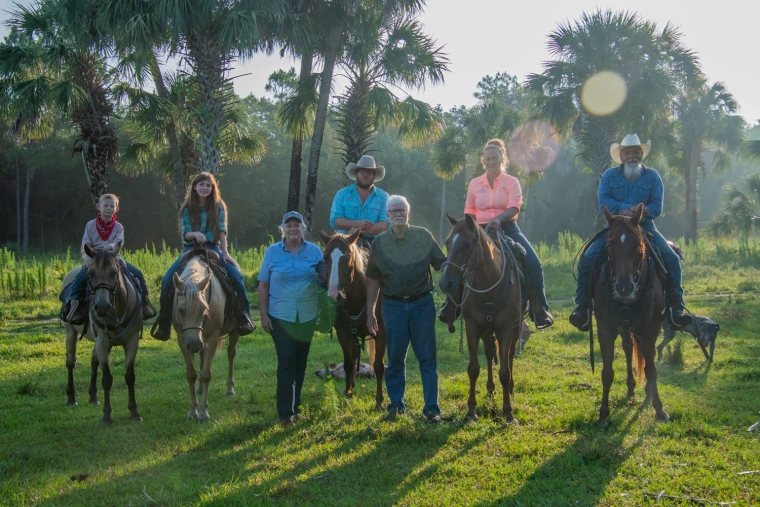
Liesa and Russell Priddy's JB Ranch was the winner of the National Cattlemen's Beef Association Environmental Stewardship Award for Region 2 in 2023. Most of us don't associate South Florida with cattle and predator conflicts. But the Priddys were the first to document confirmed panther kills of cattle in the region, and the growing panther population just north of the Everglades has caused local ranchers to begin taking stock of how to protect livestock where there are panthers in the pasture. Listen to learn about this unique environment surrounding the Florida Panther National Wildlife Refuge and the ups and downs of ranching and critical environmental stewardship between the swamp and the hyper-urbanized Florida coast.
The Art of Range Podcast is supported by the Idaho Rangeland Resources Commission; Vence, a subsidiary of Merck Animal Health; and the Western Extension Risk Management Education Center.
Music by Lewis Roise.
Transcript
Tip Hudson: Welcome to the Art of Range, a podcast focused on Range lands and the people who manage them. I'm your host, Tip Hudson, Range and livestock specialist with Washington State University Extension. The goal of this podcast is education and conservation through conversation. Find us online at artofrange.com. Welcome back to the Art of Range. My guest today is Liesa Priddy. I think that's how you pronounce your first name, right?
Liesa Priddy: That's correct.
Tip Hudson: Down in southwestern Florida, in a pretty unique environment, this will be part of a series on Florida. One of the things I wanted to visit with you about is the 2023 Environmental Stewardship Award that you guys received. I'm thrilled to be here. It's really fun to interview you in person. Welcome to the Art of Range.
Liesa Priddy: Thank you.
Tip Hudson: A lot of people will not be familiar with this environment. Even though I'm fairly familiar with the cow calf industry and where animals are in the United States, I was not aware of how many cow calf producers and how many mother cows there were in this part of Florida. I think Gene Lawless over at Buck Island said at one time, you could count nearly half 1 million mother beef cows within a few miles of I-70 or the state Route 70. There's a lot more animals here than I realized, but there's an awful lot of forage, and you sort of have to do something with it. Can you describe the environment that this ranch is on, which looks and feels a little bit different to me than some of the ones that I've seen in the last couple of days?
Liesa Priddy: Well, I always describe it as a harsh environment. Because it gets very hot. At certain times of the year, it can get very wet, which, of course, supports a very good bug population. We have to deal with that. But because of the size of our ranch and the type of forge that we have, we don't have to do any supplemental feeding of hay around. We do some supplemental feeding at different times of the year, and we have molasses out, mineral out year-round for all of our cattle. But we're not burdened with the big expense of having to buy the hay and extra feed that a lot of places have no forage in the wintertime. That really saves us a lot. But on our property, we have quite a bit of swampland where there's really no place for cattle to graze in that area because it's wet all year round. Then we have just some open prairie areas, but we also have a small percentage but some pine uplands that are good grazing areas. We do a lot of mowing and a lot of underbrushing with a mulching head on a skid steer to open up some of the areas. We've had to do a lot of exotic vegetation removal because the exotic vegetation was just encroaching into a lot of our grazing area. If left to its own devices, it would just eventually take over.
Tip Hudson: What plants are moving in here?
Liesa Priddy: The worst one that we deal with is Brazilian pepper.
Tip Hudson: Oh, yeah.
Liesa Priddy: It was brought to this area as an ornamental and not knowing in advance what would happen. It's just spread everywhere. As I said, if you let it take over, you're really losing a lot of your grazing area, which, of course, is going to cause you to have to reduce your herd size. We spend a lot of time and a lot of money every year on exotic vegetation removal.
Tip Hudson: Mostly bush-hogging it or other herbicides that are affected?
Liesa Priddy: Well, what we normally do is if it's too large for our mulching head on our skid steer to take care of, we actually have to go in with the front-end loader, with a rake on the front.
Tip Hudson: Rip them out.
Liesa Priddy: Rip it out. Burn it. Then we go back, and we spray it with the herbicide, whatever's left, and then you have to spot tree. That area every year thereafter. I mean, you have to keep an eye on it, because if you've got disturbed ground, the chances are that Brazilian pepper is going to want to take hold in that area.
Tip Hudson: I've seen a lot of smut grass that seems to be a concern further north.
Liesa Priddy: We have smut grass, too. We don't try to eliminate it. We try to control it to where the cattle will eat it, which is really what the mowing does for us. If you keep it mowed and let that green new growth, come back, the cattle will eat that.
Tip Hudson: You guys are primarily a cow-calf operation?
Liesa Priddy: Exclusively a cow-calf operation. Yes.
Tip Hudson: It seems like everybody else is either in the middle of or just finishing up calving season.
Liesa Priddy: Yes.
Tip Hudson: Are you working with that same window?
Liesa Priddy: Yes. We start calving late September. And we have about a 120-day calving period. We're in the middle of it right now. But hopefully, the majority of our calves have already been born because, of course, we're wanting to tighten up that calving schedule, so that they can put on as much weight as possible before selling them in the summer. Years ago, we didn't have a calving season. The bulls were out with the cows year-round. But that's just not an efficient way to operate. We changed that quite a while back to where we started a horse, not at 120 days. It's probably more like 160 days and worked our way back. It's hard for us to get to less than 120 days because our pastures or big open areas, and those bulls have to travel big, long distances.
Tip Hudson: With year-round calving or something like it, would the practice have been to gather up a couple times a year and then sort by weight and ship some?
Liesa Priddy: Well, back when there was no calving season, we still only had one big roundup a year. We just sold at the local market. We didn't do any shipping because we didn't have enough conformity to our calves. To sell it at auction and make a full load. Similar animals. Back in the day, you might send calves that were six months old with calves that were 18 months old. I was hit and miss. We've changed a lot in the last 15-20 years.
Tip Hudson: What is the history of this particular ranch?
Liesa Priddy: Well, we have records of the ranch going back to the 1920s, and at that time, the property was owned by their Collier company, which the county is named after the Collier family. They leased the land to a couple of guys that ran a ranch on it. Our ranch name is JB Ranch, and those letters, JB, were the last initials of the two guys that owned and operated the ranch. My grandfather was a big hunter, and he got a hunting lease from the Collier family. He hunted, and then there was a ranching operation going on. The patriarch of the Collier family died, and they faced having to sell some property to be able to pay estate taxes. This was in the early 50s. My grandfather bought the property. After a while, I bought the ranch operations from the two guys that had been running it. He then had full hunting, ranching operations and owned all the property also. Then my dad ran it, and now my family's running it. We're the third-generation owners of the property.
Tip Hudson: How many acres are part of what you run catalog?
Liesa Priddy: Well, the total ranch is about 10,000 acres, but not all of it will support a cow.
Tip Hudson: I think you're the first rancher I visited with who's been a recipient of the NCBA's Environmental Stewardship Award, although I've got several in the lineup in the next couple of months. For those that are not familiar with the history of that award, can you describe the NCBA's Environmental Stewardship Award?
Liesa Priddy: Well, it's a program that recognizes ranchers throughout the country that have put environmental stewardship at a high part of their goal of how to run their ranch. We always tell people our goal is to leave it better than we found it. We feel we've done that. I think my dad did that, and probably my grandfather before him. The NCBA is divided up, I think, into seven regions. Someone nominates a ranch, and you fill out an application. You basically summarize all your ranch operations based on a guideline that they give you, what they want to hear about, like your involvement in ranching, outside of just operating your ranch, cultural resources that might be on your property, environmental practices that you've implemented. Are you using other folks to help you make your operation better, just touching on every aspect of running the ranch? The competition, to me, it's tough when I've seen other people's applications. We were really excited that we won for the region. When we saw who we were up against nationally, I think it'd be a hard time if I was a judge. Everyone was just superlative. Their operations, and it had to be a tough job to pick the winner.
Tip Hudson: You guys ended up being a national winner?
Liesa Priddy: No, we are winners for our region.
Tip Hudson: You're regional winner.
Liesa Priddy: I might just be five regions. We were the region five winner.
Tip Hudson: It's my sense that ranches are increasingly recognized for providing wildlife habitat, even in parts of the West, we had a lot of public land because the private land tended to be the higher value stuff that people would settle on. Although I think that's not as widely known among the general public, and I feel like that's part of our job, people like me and ranchers to tell that story. I think that is gaining awareness, as well. But providing habitat has its ups and downs. It's one thing if you're generating habitat for meadow larks. It's another thing if you're providing habitat for keystone predators.
Liesa Priddy: Yes.
Tip Hudson: If I think I'm right, you're just a little bit north of the National Panther Reserve.
Liesa Priddy: That's the National Refuge System.
Tip Hudson: How old is that refuge, and what's the history of Florida is known for Panthers, but what's been the trajectory of the Panther population?
Liesa Priddy: I'm thinking that was probably started maybe in the 70s, 74, 76 stick in my mind. The trajectory of the Panthers has been upward in terms of their population. Probably about I'm trying to think of the year, early 90s, I saw my first Panther. Before that, I heard stories of only two other Panthers on our ranch, one by a hunter and one by a cowboy. They were in short supply. They're very elusive. It's just not a predator that we were even concerned about. Didn't come on our radar at all. Then, in the 80s, there was a reintroduction to the species brought in from Texas. These Texas cougars they were females bred with the indigenous Panthers. That served to widen the genetics of the cats. It was successful. There were two particular genetic defects that characterized Panthers. One was a kinked tail, and one was a **** between its shoulders on its back. They also describe heart problems. Some holes in the native Panther's heart.
Tip Hudson: In the indigenous population?
Liesa Priddy: I'm sorry.
Tip Hudson: Those were the defects that were known inside the indigenous population?
Liesa Priddy: Yes.
Tip Hudson: As a result of inbreeding?
Liesa Priddy: Yes.
Tip Hudson: Got it.
Liesa Priddy: That's why they brought in these cats from Texas.
Tip Hudson: Where were they released?
Liesa Priddy: They were released down here in this area. About 17 years ago, we noticed that our calf crop was just not what it had been historically. For a rancher, that's catastrophic because that's your bread and butter. That's how you get paid: is selling those calves. We weren't finding carcasses, so we didn't attribute it to disease or anything tangible that we could address. It's like you have a problem, but you don't really know what to do about it because you don't know what's causing it. About that same time, people talked more about seeing Panthers, and we started seeing more Panthers. We felt that might be one of the reasons that our calf crop was decreasing is that they were being predated upon by Panthers.
Tip Hudson: It's one thing to lose two or three. You start losing two or three.
Liesa Priddy: 30, 40 calves. In discussing it with the wildlife officials, they totally dismissed it. But no, that's not the Panthers' prey. Their primary prey are deer and hogs. Well, one of the things that supported our theory is that we had no hogs on our property at all. In most places in Florida, hogs are a nuisance. They're like rabbits; they just multiply like crazy. Our theory was that our hogs were gone, so Panthers were moving on to another food source. Didn't really get any buy-in from any of the, either the Florida Wildlife Agency or the Fish and Wildlife Service either because they both have Panther programs. Do Panther research. Of course, they're scientists, so you've got to prove everything. I've got a small herd of cracker calves, which is their descendants of the original cattle that were brought to Florida by the Spanish. I watch them really closely. I keep them by my house. I keep track of them. They have names.
Liesa Priddy: I was starting to miss some of my cracker caps, real young ones a couple of weeks old. But again, no evidence, no carcass, nothing. We thought it was Panthers. We had a friend volunteer to sit out in our pasture with night vision equipment, and sure enough, he saw a Panther come in and grab a calf and could barely scare the Panther away. My husband and I happened to be in town for dinner. We drove home, and he had guarded that calf the whole time to make sure the Panther didn't come back. It's not a pretty sight to see an animal after a Panther has attacked it. Call the fish and wildlife agency. Even though it was late, they did send someone out and we showed them the calf, and they said it looks like evidence of predation.
Tip Hudson: That was about 10 years ago?
Liesa Priddy: No, it was probably more like 15 now.
Tip Hudson: Okay.
Liesa Priddy: They came back the next day and found panther tracks. During the night, the Panther had come back and taken the carcass off. But after that happened, I lost about four or five more calves. Some of them we were able to find the carcass. Some of them we weren't because normally a Panther will cache a carcass.
Tip Hudson: Right. Hide it.
Liesa Priddy: Come back to it. But these were so small, probably just carried it off.
Tip Hudson: Carried off.
Liesa Priddy: That was really the first proof where the wildlife agencies would acknowledge that, yes, Panthers are predating on calves. They're protected under the Endangered Species Act. You can't harass them in any way, and certainly you can't kill them. There aren't many tools to use. It has some parallels to the wolf situation out west. Some of the options that we looked into were guardian livestock dogs. People wanting to protect the Panthers said, “You need to have range riders every night. Or you need to.
Tip Hudson: Pin everything up or something.
Liesa Priddy: Bring them into the barn every night. When you have 10,000 acres of cows. You just it's not reasonable. This isn't a dairy. It's not the same thing. The only thing that I found that worked for us that was feasible was I call them guardian donkeys. I put donkeys with my carcass cows, and I haven't lost one to a predator since then. It's not feasible to do in our main herd or commercial herd because they are spread out over so many acres. Donkeys will stay together in a group. It's not like they get together and say, you four go with this group of cows and you four donkeys go with this group of cows. In a big setting, they're just not feasible. Dogs aren't feasible for us, either.
Tip Hudson: I know donkeys have worked pretty well for a lot of sheep ranchers. Of course, the sheep mostly stay together a lot more than them.
Liesa Priddy: The cows do.
Tip Hudson: Cow herd does.
Liesa Priddy: But like I said, that's the only thing that we found that works, but it only works for my small herd. It's been a very expensive thing to deal with. We've tried using programs from the Farm Service Agency. They don't really work well for us because they want you to confirm with a carcass. Panthers usually don't leave a carcass.
Tip Hudson: Especially if it's a calf.
Liesa Priddy: Every time you lose one, you'd have to be calling either state or federal biologist to come out and confirm it. The red tape in that program is just outrageous. They pay you a small pittance of animals really worth. Just this year, our state wildlife agency came up with a payment for ecosystem services program, which I've been pushing for at least 10 years. Finally, this year, we were able to come up with one we applied, and we were approved for it. It's aimed at making sure that you continue to provide good habitat for Panthers. But really, it's a way to compensate us for our losses. I'd rather have my calves than compensation. It's just not a good feeling knowing that your calves are being killed that way. It's not a very pretty way to die.
Tip Hudson: I assume the normal prey would be other small mammals and deer?
Liesa Priddy: Deer in our case, should be their primary food. We have a very robust deer population to the point that it can support the Panther population. But when calving season starts, a calf is easier to catch than a deer. They go after the calves, and then only after they get to about 350, is about the largest calf we've ever lost. They can kill an animal much larger than themselves. If a Panther weighs 140, it could easily take down a 280-pound calf. But what we've told our northern ranching neighbors, because it's been our problem alone for so long, because there were so few Panthers. Is whenever you see your hog population going down, you know that you have Panthers. Over the years, mostly within the last five years, I've heard from several. You're right. We're seeing our hog population going down because of course the objective of their Panther program is to continue to increase the population and move it north into more of its historical range.
Tip Hudson: I spoke yesterday with Joe, one of the biologists working with Archbold Station.
Liesa Priddy: I know, Joe.
Tip Hudson: He said to tell you hi. He said there had been a few mostly lone males that had swim the river and gone north of the Caloosahatchee, but he believed that there was not yet a breeding pair working north of the river.
Liesa Priddy: They've documented kittens north of the river?
Tip Hudson: Yeah.
Liesa Priddy: There has been at least one, but personally, I feel that there's more based on.
Tip Hudson: Than what the biologists think.
Liesa Priddy: Definitely, because ranchers are outside on their property all the time.
Tip Hudson: We're in the middle of it.
Liesa Priddy: They have the opportunity. The other issue is most ranchers don't want the wildlife services on their property. We're very private people. We don't publicize what we do, how we do it, what we see. For that reason, I just don't think that there's any way for science to, it's like counting fish. It's hard to really know how many they are.
Tip Hudson: You can electroshock the Panthers and then see how many float up.
Liesa Priddy: No.
Tip Hudson: In the payment ecosystem services program, what is the basis for payment? Is it by the acre or by certain habitat attributes?
Liesa Priddy: It's both. It's based on your habitat. They actually come out and do a survey of your property, and attribute how many acres of this do you have? How many acres of that? Then there's a different payment level for different types of habitat. That's how you get paid.
Tip Hudson: Back to the Environmental Stewardship Award, what were the specific characteristics of your operation that caused you to win the regional Award?
Liesa Priddy: They don't really give you that information, so I would have to guess that it's a lot of work on the exotic vegetation removal, the habitat that we have available for endangered species because it's not just the Panther. We have a lot of other endangered species that live on the property. Birds, Gopher tortoises are protected. Certain species of squirrel is protected. We have bonneted bats on the property. It's just a laundry list of things that are protected. I think being able to provide that habitat, just being very proactive in our maximize the ranch and what it has to offer. Most ranchers are diversified in some way. We're not any different. I think all of those things combined led to their choosing us.
Tip Hudson: What other enterprises do you have that are part of the ranch that provide some revenue aside from calf sales?
Liesa Priddy: We have a hunting operation. For deer and turkey and alligators. We do cabbage palm harvesting. For landscape purposes. We have folks that come in and harvest the fronds off of the cabbage palms to build chickie huts, which is you can't get more renewable than harvesting a cabbage palm frond, and then, six months later it's going to grow back. We have a rock quarry on the property. We also lease farmland to a farmer. Those are the different things that we've expanded into.
Tip Hudson: What is the breed composition of your main cow herd?
Liesa Priddy: We're transitioning right now from primarily Brangus herd into a beef master herd. We need those Brahma genetics to withstand the heat and the insects in our area.
Tip Hudson: How recent was that shift?
Liesa Priddy: We started shifting four years ago. Pretty much, we have two black bulls left, Brangus. Everything else is red now.
Tip Hudson: Then you're selling wean calves then?
Liesa Priddy: No, we don't sell wean calves. We sell calves right off the cows. We participate in video auctions with Superior. We set a delivery date, and it goes on the auction. Then most other ranchers that sell that way. You set a weight at what you're going to sell. Most buyers are looking for conformity and color, size, and so forth. We're obligated to deliver that size animal. This color animal at that date. That's the way we sell the majority of our calves, so they come right off the mom.
Tip Hudson: That's four or five weights or bigger?
Liesa Priddy: What do you mean?
Tip Hudson: What weight are you targeting then?
Liesa Priddy: About 550. About nine months. Everything gets shipped out West. All of our buyers are out West.
Tip Hudson: What has been the public response to the Panther situation? I can imagine all over the map.
Liesa Priddy: There's a lot of controversy about it. Unfortunately, agriculture and ranchers have not always been good at telling our story and what we contribute to providing habitat for wildlife. I think we're doing better than we used to. But it's an uphill battle, and the Panther is a very easy animal to attach yourself to emotionally. There's a lot of emotion on the issue. I don't know, it's just a very complicated issue. I don't know really how to break it down.
Tip Hudson: No. It's fine.
Liesa Priddy: In the facets of it, but of course, people in general, the public have very little empathy for us as ranchers having to deal with it. We hear a lot of comments like, they were here first. You should bring your cattle in to protect them, and a lot of misunderstanding. I think it goes along with some of those issues.
Tip Hudson: They're not turning their condominiums back into habitat.
Liesa Priddy: No. They're not.
Tip Hudson: The irony is that you're still providing habitat.
Liesa Priddy: It's an expensive endeavor, and I think in general; the public just expects us to eat that expense. There's efforts in Florida now, and you may have heard of the Wildlife corridor being mentioned. I don't know.
Tip Hudson: Not yet.
Liesa Priddy: Other visits. But there's an effort to buy or place in a conservation easement, a large swath of property up the middle of the state to allow interconnectivity for wildlife. The issue that I think people fail to consider is now that it's owned by the government in most cases, it's got to be managed. It's my observation that government historically are not good property managers. They are not nearly as good as those of us in ranching. We live it every single day. Government folks go home at 5:00 on Friday for the most part. We can do stuff probably at half the cost of government in terms of habitat management, mowing, burning, herbicide, exotic removal. We're just so much more efficient at doing that. I'm just concerned as the state continues to accumulate all this land that it's not going to be well managed. It's something that you referenced earlier about preservation versus conservation. I don't think you can approach land management in view of preservation, because I don't think the indigenous people did that. They used the land for substance. They managed it for them to continue living on. It wasn't hands off, don't do anything. I think we need to realize that preservationist viewpoint is not going to leave you with the type of property that you really want to see. I think my own personal view is that the land and the animals on it were placed here for man to use and take care of. I'm just concerned that a lot of that land that's being bought up is not going to end up that way. We see that with the Big Cypress reserve that we border.
Liesa Priddy: There are efforts like, don't allow any hiking. Don't allow any trails. Don't allow anything that's motorized. That's not what the property is there for. It's there for the public to use, enjoy, and protect. Not to be a hands-off type of situation.
Tip Hudson: Some years ago, I interviewed Charles Mann, who was the author of the book 1491: A History of the Americas Before Columbus. He was largely using as a source an anthropologist out of California named William Denevan, who wrote one of the more well-known articles called "The Pristine Myth" back in the 1970s. I think it was in the 70s. But he was one of the first ones who discovered evidence of what we would call more advanced civilization among the indigenous peoples in North, Central, and South America than we had previously given them credit for. In a follow-up article titled Nature Rebounds, he makes the case that much of our wilderness myth, how we idolize land that has not been touched by humans, comes from the fact that what Europeans mostly encountered when they came across North America was an untended garden because the Indians had been wiped out by smallpox 200 years prior. In some cases, smallpox moving ahead of people that were moving up river drainages and literally decimating the Indian population, where there was less than 10% of the original population left. All of the burning and wildlife harvest that was occurring for thousands of years prior to that just stopped. The earliest people that came, even to the Eastern Seaboard, found places that were open, park-like savannas that you could drive wagons through in what we think of as solid conifer forests now. I'm sure there was even more of that here. But nearly all the way across the continent, that was the case. I think we have the idea that if people don't touch it, then whatever happens must be good, as opposed to trying to develop habitat characteristics that support everything that's out there and maintaining a variety of different habitat types.
Liesa Priddy: I think the Earth was meant to have a symbiotic relationship between all living things. If just try to preserve everything, that's not going to lead you to a symbiotic relationship. Something's going to gain traction over something else that should be in balance. Unfortunately, not everything historically has been handled correctly. You look at Florida in general; the Restoration of the Everglades, one man was basically behind all the dredging and putting up levees and trying to make property available for habitation. If we knew then what we know now about water flow and how important it is to maintain that flow through the Everglades, we'd be saving billions of dollars. But yes, we made mistakes that hopefully we know better now about how to manage things because the Panthers almost were extinct because of overhunting, and the overhunting occurred because the original ranchers in the area knew that they were killing their calves. Their thought was, let's get rid of every single one of them instead of maybe managing the population. That was more than likely a mistake as well. That wasn't a balanced approach.
Tip Hudson: That period of time was characterized by that. That was more the 20s, 30s boom in the coast. But prior to that, people have observed that we killed off all the bison, but it wasn't because bison hunting is unsustainable in of itself. You just can't kill all of it.
Liesa Priddy: You can't kill everything. There used to be bison in Florida. They have, I think, some in one of the state parks in our state preserves, but there used to be. Florida was totally underwater at one point. How far do you go back? Things evolve and change.
Tip Hudson: We can't put it back to what it was, we can try to do well with what we have now.
Liesa Priddy: Yes, exactly.
Tip Hudson: What are some challenges, maybe ecological or production challenges, in the beef industry that you feel like we have made significant progress on in your lifetime?
Liesa Priddy: Think animal health; certainly, with the different vaccinations, different types of insect control, worm control, really has enabled ranchers to be more productive. Improvements in fee, knowledge of forage just better science, I think that has contributed to all of those types of approaches. It's made us more productive with the same amount of land.
Tip Hudson: Are there things that you would like to see us make progress on in the next few decades?
Liesa Priddy: I think it would be great to have better and better genetics in the cattle that we're raising for beef. Make them more efficient in turning that grass into meat?
Tip Hudson: I think it's remarkable already that you can come anywhere close to an animal that's fitted to this environment and still make a choice yield grade to carcass. That's pretty impressive.
Liesa Priddy: But I think that would be a great achievement to have them be able to just be more efficient. From what they eat, turning it into beef would just be great. I think we've come a long way on disease control. Maybe longer-acting parasite controls would be nice because you have to do it fairly often now, and it's expensive. It's very expensive.
Tip Hudson: There are other trends in how the public perceives ranching. We've visited it just a little bit, but trends that you think are either encouraging or discouraging?
Liesa Priddy: I think Yellowstone had a big impact on how people view ranching, a very romantic view, but surprisingly, while it's probably not as exciting as Yellowstone, a lot of the things that they showed in that series was very pertinent to what the things that we deal with in terms of developers trying to come in and take control over your property, government infringement and trying to micromanage your business for you, and the regulations that you have to deal with. I think that was very intriguing to the public to see some of those issues that we, as everyday ranchers, have to deal with also. As I mentioned before, I think the ranching community is doing a better job of promoting themselves. I think there's still a long way to go so that the public understands the benefits that we provide at no charge to habitat and wildlife, and retaining of property and managing it well, that is not getting developed. I'd like to see a better and better understanding from the public of that. Maybe understanding, no, we can't bring all our cows in every night and put them in a barn. I get asked so often when I tell people I'm in ranching, and they immediately think dairy. Me, that's one day and night.
Tip Hudson: They are both cows.
Liesa Priddy: My grandpa had a dairy up north, or my family had a dairy. We ended up having to sell, whatever the reason. That's what most people relate to cows in terms of dairy cows. A lot of people don't realize that Florida is such a huge producer of beef cattle.
Tip Hudson: I do think people tend to get stuck in this either-or paradigm, where it's either intensively managed agriculture, which they see as an extractive use of the Earth, or you have a nature preserve, which is automatically good, and that's a wonderful thing. I think there's something that's beginning to change. I interviewed Dan Daggett a while back. He's one of the environmentalists who was on the top 100 most effective environmentalists in the country in the 1980s, and he became a ranching advocate. But his efforts, I think, have echoed a quote from Jim Corbett, who was one of the original founders of the Mal Pie Borderlands group. But Jim said rangeland-based ranching is probably now the only livelihood that represents a true interdependence between man and wild biotic communities. It is in this middle ground where you're producing food and fiber in the same space that you have almost undiminished habitat value. I happen to think that in most cases that works both directions, meaning when you have a diverse habitat like that, it tends to be good for animal nutrition when they have access to a wide diet, and I'm glad to hear it, and I think there's some other programs like it that we're finding ways to compensate ranchers for providing public benefits on private land that have not either been acknowledged or compensated for in the past.
Liesa Priddy: The very frustrating part of that, as I advocated for a payment for ecosystem services program for so long, is I just don't think it was a sexy program, and I would see literally millions of dollars going for other Panther issues. The rancher, almost exclusively, was providing the very best habitat in Florida and continued to garner criticism for it. Panthers used to be fairly prolific in the Big Cypress National Preserve and Everglades National Park. They just aren't anymore. They've moved on to better habitat because there aren't any prey animals left on government lands. The government made all of the ranchers that lease property remove their cows and cancel their leases. They've ended up with overgrown, unpenetrable habitat that nobody can use for anything. There's almost no deer left. There's almost no turkeys left because the preserve is open to hunting. We get that on-the-ground reporting; people that used to harvest deer and turkeys come back and say, "I was out there two weeks." I didn't even see a deer. I saw, like, one track. It's extremely sad to me to see how the public lands have been degraded in terms of wildlife because it just hasn't been managed well. That's the bottom line. Of course, they say we don't have enough money. That goes back to what I was saying before about this race dry everything in Florida for preservation of public lands, but the management of it is going to be a whole other story.
Tip Hudson: It's like you're providing a private zoo, and at a small fraction of the cost of what the government could run it for.
Liesa Priddy: Why wouldn't you want to support the owners and the lands that are most productive to wildlife? But it didn't happen. The program that we're using is experimental to see how it works.
Tip Hudson: It's unique to this county?
Liesa Priddy: No. I was available to really anyone. I'll take that back. I think there were only certain counties that could apply for the funding. There were, of course, more applicants than money available. You're guaranteed funding, I think, for three years under this program; you get an annual payment. You have to allow one inspection a year, which is very doable. We don't have any problem with that. We want you to see that we're using the money we get to continue to improve. That's what it's about. We don't mind being held accountable for what we say we're going to do. I hope it's something that does spread and that funds that perhaps haven't been spent as wisely as they could have been in the past are diverted to something that I think is much more productive and successful.
Tip Hudson: That is encouraging. Is there anything you wanted to say that I haven't asked about?
Liesa Priddy: I think the other thing about ranchers is we still see each other as neighbors and wanting to help neighbors out. I think a lot of that philosophy and outlook on life has diminished over the years as people have moved out of the rural setting into a more suburban or urban setting.
Tip Hudson: Ironically become more isolated.
Liesa Priddy: Yes, and have more problems. But it's a great way of life, and it's not easy, just like any other type of businesses are always easy. We're self-employed people. We got to write a paycheck to our employees, and we're not makers in the market. We're takers in the market. We don't get to set what we sell ours for. You got to be a gambler to some degree and love what you're doing to stay in it.
Tip Hudson: Thank you for staying in it.
Liesa Priddy: Sure.
Tip Hudson: Thank you for what you do. Thank you for your time today.
Liesa Priddy: Bye.
Speaker 1: Thank you for listening to the Art of Range podcast. Links to websites or documents mentioned in each episode are available at artofrange.com. Be sure to subscribe to the show through Apple Podcasts, Podbean, Spotify, Stitcher, or your favorite podcasting app so that each new episode will automatically show up in your podcast feed. Just search for Art of Range. If you are not a social media addict, don't start now. If you are, please like or otherwise follow the Art of Range on Facebook, LinkedIn, and X, formerly Twitter. We value listener feedback. If you have questions or comments for us to address in a future episode or just want to let me know you're listening, send an email to show@artofrange.com. For more direct communication from me, sign up for a regular email from the podcast on the homepage at artofrange.com. This podcast is produced by CAHNRS Communications in the College of Agricultural, Human, and Natural Resource Sciences at Washington State University. The project is supported by the University of Arizona and funded by sponsors. If you're interested in being a sponsor, send an email to show@artofrange.com.
Speaker 2: The views, thoughts, and opinions expressed by guests of this podcast are their own and does not imply Washington State University's endorsement.
NCBA Environmental Stewardship Award story on JB Ranch.
Watch the Priddys' award video here