

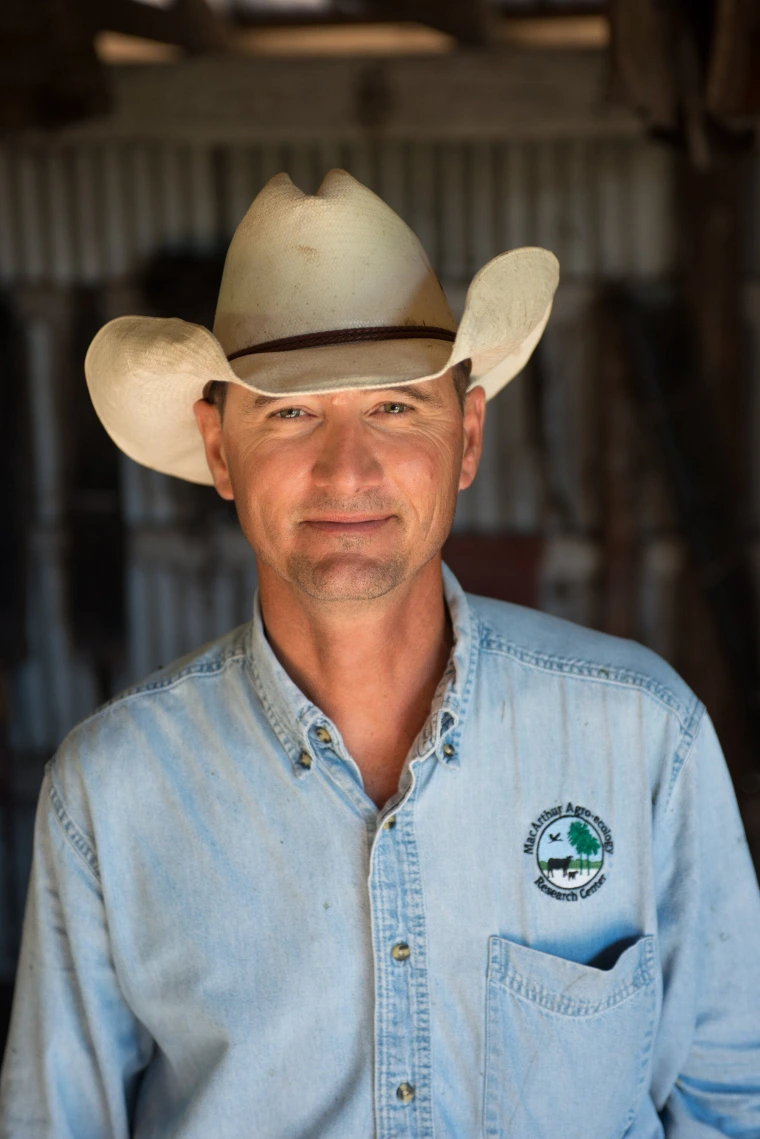
Gene Lollis has been managing the Buck Island Ranch for both commercial cattle production and research objectives for over 30 years. In this interview, Gene covers carbon life cycle analysis and eddy covariance sensors, meat packer politics, endangered bird species, Florida feedlot rations, rotational grazing, and national security. Welcome to a day in the life of a rancher. Archbold Biological Station is one of the largest privately-funded and operated ecological research institutions in the United States. Since 1/5 of Florida's land is in ranches, they recognized decades ago the importance of doing research on working cattle ranches. Archbold leased the Buck Island Ranch from the MacArthur Foundation for many years before purchasing it in 2018. Today, the ranch hosts numerous environmental research projects run by Archbold, including a LTAR site, and raises ~3000 cow-calf pairs per year.
Music by Lewis Roise.
Transcript
Tip Hudson: Welcome to the Art of Range, a podcast focused on rangelands and the people who manage them. I'm your host, Tip Hudson, range and livestock specialist with Washington State University Extension. The goal of this podcast is education and conservation through conversation. Find us online at artofrange.com. Welcome back to the Art of Range. My guest today is Gene Lollis. He is the manager of the Buck Island Ranch, a commercial cattle ranch that's attached to the Archbold Biological Station. I had the pleasure of getting to spend some time with Gene a few weeks ago in Florida, but we're not recording in person today. I hear he's got some cold weather, but not quite as cold as the North, but colder than they've had in a little while in South Florida. Gene, welcome.
Gene Lollis: Thank you very much. I appreciate the opportunity to be here today.
Tip Hudson: My first exposure to South Florida was, I think, in 2003, on a ranch tour, and it definitely challenged some of my assumptions about what Florida looked like. I think this is common for people that live somewhere and don't know something about somewhere else. I grew up in Arkansas and moved to Washington State, and I thought Washington was all forest. But of course, I live in sagebrush desert with 8 " of precipitation, which still surprises people because they don't think of that as what is in Washington, at least the ones that don't live around here. Having never been there, I thought Florida was all swamps and coastlines until I visited there in 2004 on this ranch tour hosted by the National Association. I was blown away by how much ranch land there was and how many cattle there were. One of the main stops on that tour was Buck Island. I think you were probably there then, is that right?
Gene Lollis: That's correct.
Tip Hudson: Let's start with how long you've been with the Buck Island Ranch, and then we'll talk a bit about the history of the place.
Gene Lollis: I've been here on Buck Island Ranch now, in my 33rd year. Actually, when I graduated from the University of Florida, my goal and dream was to become a veterinarian of all things. I got a job offer here at Buck Island Ranch. Which was known then as the MacArthur Agroecology Research Center. I got offered a job and went back, and I asked my mother. I said, "I know you want a doctor in the family, but I got a job opportunity," and she said, "Well, son, you've got to do what makes you happy." I took the job and graduated from college and have been working there ever since.
Tip Hudson: Have you ever regretted that you didn't pursue the veterinarian track?
Gene Lollis: No. This has been a blessing in disguise because this has been a great opportunity to fulfill one of the things that my family was in farming and ranching, but like in the late '50s, and '60s, like some families, the farm dissipated, went away, and so you went to town and got another job. My father went into construction, left the family farm and whatnot, and it dissipated away. I didn't have the opportunity to inherit or buy a ranch, so I got to actually run one, which has been truly a blessing.
Tip Hudson: You said that it was at one time, known as the MacArthur Station. I think I read that this was owned by John MacArthur, as in the John D. and Catherine T. MacArthur Foundation.
Gene Lollis: That is very correct. In 1988, the Archbold Expeditions Inc., which is a very environmental oriented organization, family-owned organization up on Lake Wales Ridge, came across the opportunity to lease the property from the MacArthur Foundation. It was set up on the premise of doing environmental-type research, so you look way back then, a lot of those things, I always say, was not very cool. You know what I mean by looking at the environmental side of things with agricultural-type operations.
Tip Hudson: When was it? Was it the early '70s that the MacArthurs had the place?
Gene Lollis: Mr John D. MacArthur purchased this ranch in 1968. They ran it as a full-scale cattle ranch and citrus at the time, from 1968, and he passed away, if I recall correctly, in 1978, and that's when he had already set up his large foundation. The foundation took it over. If I recall correctly, they ran it another eight years past his passing, and that's when Archbold came in to say, We'd like to lease the ranch.
Tip Hudson: Do you know what the history of the ranch was prior to MacArthur's?
Gene Lollis: Yeah, well, it was owned by the Durrance family, Ralph and JC Durrance. It was a family-owned ranch. If I recall correctly, one of the stories that I was told, one of the brothers got ill and got sick, and they ended up having to sell the ranch to help that type of situation.
Tip Hudson: That's a fairly common story.
Gene Lollis: Yep. Then we trace it back as open space or as a ranch, all the way back to, I think, 1841, just different ownerships and different types of situations, like our neighbor Lights Brothers, I think at one time, leased it, and then fractions of it was owned by others, and then it became probably the Durrance family and then became Buck Island Ranch through John D. MacArthur in '68.
Tip Hudson: Do you know where the name came from, Buck Island?
Gene Lollis: Actually, Buck Island Ranch, the name, was derived from Billy Bowlegs, and we think it was Billy Bowlegs III. This was his favorite hunting ground. As you mentioned, Florida is known for its swampland, and this was a big, vast, we call it the Indian Prairie. The water during the summertime will be extremely wet, and there was about 2000 acres that would stay out of the water, and that's Buck Island. All the game would come to these 2000 acres, so they would canoe. The Seminole Indians would canoe in here in the summertime, and this was one of his favorite hunting grounds.
Tip Hudson: Wow.
Gene Lollis: Technically, we mentioned winter seasons, this part of Florida usually had two seasons, wet and dry.
Tip Hudson: For those that are not familiar with the geography of South Florida, describe where Buck Island is at?
Gene Lollis: Coming from Lake Okeechobee, everybody's familiar with Lake Okeechobee, that big round water spot in the state. We're located about 18 miles as the crow flies northwest of that. We're right off the Lake Wales Ridge. The Lake Wales Ridge is, of course, the high spot. We're sitting at about 31 feet elevation. Our main station is sitting around 80 to 100 feet, with the highest point right around 190 feet, if I recall correctly. [LAUGHTER] We're right off that ridge. It's a mountain range in far south Florida. We're down in again, what I call the Indian Prairie, which was a great, big, vast open grassland mixed with water. Again, dry season and wet season.
Tip Hudson: We've now released a couple of the interviews, the one with Mike Adams. Mike said to tell you hi back. Lisa Pretty talking about Panthers and then Clint Richardson at the Deseret. I tried to get all of them to say a little bit about, I guess, the magnitude and the cultural significance of cattle in South Central Florida. But what I got out of them didn't quite scratch my itch. I'm pretty certain that you were the one who told me, when we were riding around on the ranch, some stats about the number of beef cows spanning Highway 70, that east-west highway that goes to or through Okeechobee. Can you say a little more about the history and the size of beef cattle production in South Florida?
Gene Lollis: Yes, sir. I think we're all humble, and we don't like to, I guess, brag about it or tell about it, but very significant, as you mentioned, Highway 70 that runs across east to west across Florida in this part of Florida. It's about a 100-mile stretch. Thirty years ago, if I recall correctly, there was no other road in the continental United States that you could go pick up as many calves in 100 miles than Highway 70. The number used to be up there, north of 350,000, 350,000 is the number that rings in my mind. Maybe it's easy to remember, but I think it's a little more than that, so very significant. Today, those numbers are not there, but it's still fairly significant. Our neighbors are like brothers, they have 10,000-plus head of cattle. We have 3,000, and quite a few people up and down this road are three to 4,000 plus. But they used to be a lot more than that.
Tip Hudson: How many acres are on the Buck Island ranch? You said you're running about 3,000 mother cows. How much acreage is that?
Gene Lollis: That's 10,500 acres. The ranch is set up with two-way water control, seepage irrigation, and then gravity flow for drainage. Drain 1 " of rainfall in 24-hour period. Really set up nice, we have about 4,500 acres of what we call improved pasture, which today is not as improved as it once was. Then about 55 to 5,600 acres of semi-native or semi-improved pastures.
Tip Hudson: For those that are doing the math in their head, that's about three acres per cow per year, right?
Gene Lollis: That's about right. Yes, sir.
Tip Hudson: That's crazy.
Gene Lollis: The one thing here is we produce a lot of forage. Except for this little cool spell that we're seeing here, grass typically has a little bit of growth all year long.
Tip Hudson: I've heard a number of different kinds of animals that people are running in Florida. What is the breed composition of the cow herd there at your station, and maybe that's a good segue into talking to some about the research there, has there been any formal research into the relative fitness, I guess, of different breed compositions, specifically at Buck Island? Then what is it that you guys are running right now?
Gene Lollis: Again, the research we've always conducted at Buck Island has not really been on the production or breeds or this, that, and the other because it's more environmentally focused. We study birds, we study waters, we study soils. However, we've kept to the historic history of the breeds that work in this area. Brahman and cross female, a half-blood to a three-quarter-blood-type Bahmer cow. With that, we try to keep a rotation and try to do cross-breeding. We always try to do a crossbreeding session, two to three breed rotations. We have crossbred cows, so we typically will crossbreed them back with an Angus, Hereford, or Brahman bull. What we do is when we get a cow that's a little less Brahman phenotypically and genetically, less Brahman, a little more English, or a little more exotic, I guess I should say, we put a Brahman bull back on them, and then those females will go back out to a Hereford or an Angus bull. In a day, we do utilize a few, we utilize some Charolais bulls, as well. That's Bahmen, it's just heat-tolerant. We're hot way more than we're cold. Heat parasites and just can take these flat, what we call these woods down here, and these open praries a lot better because if it draws blood here, it's here. Mosquitoes, flies, you name it, they're here.
Tip Hudson: I just recently heard a talk by the Nevada state veterinarian about the risks of New World screwworm. Of course, there's some concern in Southern Nevada. There's concern everywhere if it comes across, but the risk is quite low compared to some place like Florida. I think he even said that one of the outbreaks that didn't end up going anywhere, back maybe in the, I can't remember which decade.
Tip Hudson: But it ended up I think, somewhere down in the keys, and then they ended up stopping it. Do you have any history on that?
Gene Lollis: Yes, that's, if I recall correctly, it was 2016, and the screw worm came in on a dog on someone's. I think it was a yacht. Came in, got into the Key deer down there [OVERLAPPING]. Of course our Florida Department of Agriculture Consumer Service has really got on that pretty heavily, got down there, was able to get it contained before it got on into the mainland of Florida. For an industry, we're very grateful and thankful that it got stopped there. Sure.
Tip Hudson: For operations that well, you do some meat sales on the side, how there's currently not much feeding operations in Florida, am I right?
Gene Lollis: That's correct. There's very few.
Tip Hudson: How do you do? Do you find some other way to fatten local cattle? On smaller scales or are you bringing them back in from somewhere?
Gene Lollis: Most of everything is within Florida. We do purchase a few cattle out of South Georgia. But basically, we got started in that. With a group of ranchers, we had a group called Florida Cattle Ranchers, and it actually still exists today. Mr. Don Quince and his wife still run that up in North Florida. We run cattle and meat operations personally for about ten years. But my wife and I still continue to do that today, just in a little different format, a little different structure than working with all the ranches. Now, how did the Archibald Buck Island Ranch get involved with that is. We were looking to work with those ranchers to be able to do lifecycle analysis of raising cattle in Florida from birth to finish and compare that to what we had done historically of shipping a calf out of Florida to Panhandle Texas, Oklahoma, Kansas, where our cattle typically end up historically. Our goal was to look at, on a science basis to get that life cycle analysis. But we fell in. COVID drove us to the meat business, even as the Florida cattle ranchers. Personally today, and it just kicked off during that COVID period.
Tip Hudson: The life cycle analysis was with regard to carbon?
Gene Lollis: Mainly looking at the carbon situation. Correct.
Tip Hudson: I can imagine there are a number of challenges in trying to run a working commercial cattle ranch on a research station where there are always needs for graze here. Don't graze there, graze like this right here, graze like that over there. What has that looked like? Is that largely fall on you?
Gene Lollis: Well, I mean, we've got a great science team, great with doctor Betsy Bouton I think you know very well. That's how we got connected with you. Over time, being over 30 years, and if I can just talk about it a little bit, we started with birds, and, all the scientists were ornithologist. Over time, it wasn't a whole big impact because we were just starting up and we were looking at what was going on and a lot of people will say, what's the big deal about birds? Well, as they started over a 10, 20, 30 year cycle here, we've learned that, there's 176 different bird species that frequent this ranch. In the ranching community going to think, that's no big deal. I see them all the time. But as we all know, there's only 2 percent of us that are in agriculture today. We see this stuff. We're used to that stuff. We get a little complacent to it. But when I can go give a talk over on a coastline where 80 percent of our population live that think that we're the problem to their water problems, and you can share with them that there's 176 bird species. Nine of those are threatened or federally threatened species that come to these ranches. They get a different outlook. What I'm saying? That we're doing more than producing protein. We're keeping open space, water recharge. We're doing all these things. We're protecting the wildlife and giving habitat for the things that a lot of people like to look at, birds. That was a big starting there. But over time as we moved in, one of the big question was water. Quantity, quality. We started doing research on stalking rate because they're in the early 90s, late 90s. Powers to be we'd say that cattle are the problem. Cattle is causing the phosphorus down in Lake Okeechobee. Well, beings who we were, we set up. Through the Cattlemen's Association, through the Water Management Districts. Through all the people, the Nasers and everybody came together to formulate a large scale research project on a full scale. We took no stalking rate, low stalking rates, medium stalking rates in a high just to look at how the cattle number impacted water quality. With that, we found, basically, the cow wasn't a problem. It was historical management decisions over time. That's what we were able to show on that. But to get back to your question, it's just managing through it. If we take a block and we say, we're not going to graze this, we just have to manage around it, adjust things to make it all work.
Tip Hudson: I'm glad you mentioned that. What you're referring to with the things that folks from the coast need to know about, is that these ranches are providing public ecological benefits that everybody benefits from on private land. Historically, there's really been no mechanism to reward the people that are providing those public benefits. I think it sounds like there's a few systems set up to do things like that now with water management and wildlife habitat both.
Gene Lollis: Yes, there is. As we work through the stalking rate experiment with cattle, of course, research and science is always a new question. There's always a question. When we came out of that, we said, what can we do to maybe attenuate or slow the rate of nutrients leaving the property. That started the next project, which was the Florida Ranch Lands Environmental Service Program or pilot project. Then, we got started in that where we said, what if we blocked off or held up some water attenuate the flow, slow the rate at which the water leaves the ranch. We did that project for about ten years, and we learned like in the first year, they say, can't do that because it's going to increase the amount of the nutrients actually increased the first year. But then the next year, they actually lowered a little bit, and then next year, they lowered another bit. But it's all driven by hydrology. You know what I mean? It's like I always say a research project. They never can learn.Three years, you don't learn anything. Nine years, 10 years. You're now starting to see some cycles. In 20 years, you see some trends. That's the uniqueness about Archer Ball in its work is its long term. Since we're privately owned, we're not bound by a three year or four year deal. We can collect data for long time. What you find over that is you need three years of wet, three years of dry and three years if there's ever such thing as normal or average. You collect that data over time so you can see the impacts of a decade and longer. That's the uniqueness.
Tip Hudson: It's a little bit unusual to have a privately owned research station that's quite that large. I guess I don't know off the top of my head how many others might be like it. But my sense is that there's not a lot. To your point, these public research stations owned by universities used to have a little bit more stable ongoing funding, but most of them now are driven by grant cycles, which I think is what you're referring to with a two to three year deal. If you've got three years of money, you've got to come up with all the results, in two to three years and then write it up.
Gene Lollis: Correct. That's what I was referring to.
Tip Hudson: Do you know of other large private research stations?
Gene Lollis: There's a lot out there. But I think the focus. If you take a lot of focused on the production side of one thing. There is more specifics on individual type things, where the research that we do here, we always try to encompass the system. We're trying to look at it as a systems approach and not pick out things. We try to tie everything together. We look at the economics. We look at the environmental consequences. We look at the production consequences. We are looking at the system as a whole and not fragmentizing it and say, we're going to use this, I'll use supplemental. We're going to use this supplement, and we're going to focus solely on that, and that's how it impacts that. We look at the whole systems approach at it.
Tip Hudson: I am going to interview Betsy probably next week. We'll talk about it some, too, but she may be, describing some more of the history of the station and some of the research going on, but I'm curious, what were the findings in that lifecycle analysis looking at carbon?
Gene Lollis: Looking at carbon. If we look at carbon in this ranch, we learned that we are carbon sink. We also learned over that timeframe that on a methane basis, that boy, we produce a little more methane coming off the ranch just by a natural cycle or wetlands get wet. Water in wetlands, microbes. What are microbes eating on forage, vegetation? What are they producing? Methane. We saw over time that cattle and no cattle do produce methane, but on an overall basis, if I remember the numbers it's 19 to 20 percent of the methane is being produced by the cattle. I think it might be 22 percent. Anywhere 78-80 percent of the methane is taking place by the environment, the ground and the wetlands themselves. But Betsy will be much better on elaborating and telling that story a bit.
Tip Hudson: Sure.
Gene Lollis: But the other huge thing is that being a carbon sink. That we are able to store a lot of forge and that's a year round, year to year basis. Because we're emitting something, but we do at the end of the day, we are net sink.
Tip Hudson: Much of that storage is below ground.
Gene Lollis: Most of that storage is below ground, yes, sir.
Tip Hudson: I have a dumb non Floridian question. Is methane what stinks in a swamp?
Gene Lollis: I would think that's probably the truth. I'm not 100 percent sure, but I would say that's what the smell is.
Tip Hudson: Right, you're smelling the products of microbial decomposition of all of that vegetation.
Gene Lollis: All of the vegetation.
Tip Hudson: What has been one of the most interesting research projects to you personally?
Gene Lollis: I think they all are relevant and putting them into real world scale. Like I said, studying the birds, and then looking at the impacts of the cattle on water quality, then now moving into the new world of this carbon stuff is very eye opening. Ranching and cattle industry have a great story to tell there, and I know we're not allowed to say carbon, and we're not allowed to say methane. We're not allowed to say these things. But I believe that we need to stick to a common message. I think in the cattle industry now, I think we've gone from sustainability to resilience to regenerative. Now we're at regenerative. I think there was another word in there, too, somewhere along the line that I forgot. But I mean, they all mean the same, don't they? A buzz word of the year or the day. I think we have a great story to tell and what we do across this country with that. I'm going to say agriculture. I'm going to get on my soap box there a little bit because, as a friend of mine from Hawaii always says, he says, if you look at the GDP of agriculture on the United States, it's what? One to 1.5 percent, maybe two percent of our GDP.
Gene Lollis: But it is the most important 1% to 2% because without it, we'd literally starve to death. Does that make sense? Because, at the end of the day, if we as a nation don't recognize and realize, we talk about energy independence, energy and fuels the same. But we need to do our doggone dang disk to make sure we are food independent or at least the bulk of the foods that we eat and produce, we need to produce right here in this United States, and to be able to be, food independent. Sorry, I got on my soap box.
Tip Hudson: No, it's a good soap box. In fact, I think it was a group I was talking to just a few weeks ago about an article that Jerry Holechek, who's a range scientist out of New Mexico, wrote a few years ago, making the case that doing range lands based livestock production well is a matter of national security. His point was, if we can grow food without a lot of petroleum based inputs and can grow food and fiber in the same space that we're providing wildlife habitat and clean water, that's probably something that we ought to be giving some attention to, and to your point regarding agriculture in general, I don't know yet what I think about all the buildup of infrastructure and the billions and billions of dollars supporting artificial intelligence, but we do still need food and clothing and shelter, regardless of what we're doing with pocket computers, and those things are not coming out of a data center.
Gene Lollis: That is 100% correct. We talk about national security. National security is our food production security because without it, I don't know if you'll be very secure. I had a gentleman tell me once. He said, you know why France and some of the countries during World War II fell as fast as they did is simple. They cut off the food supply. When you cut off the food, people don't keep going very long.
Tip Hudson: In fact, that was the driving force behind some of the scientists and engineers that figured out how to make nitrate out of the atmosphere. The Germans knew that the British controlled the oceans and if the British decided they wanted to stop shipping Guano from these mountains of Guano off the coast of Chile, they could do it. Then the German farmers would be up a creek without a paddle, as they say. They began doing research on how could we make our own nitrogen. What do you think is the future of Buck Island Ranch?
Gene Lollis: I think we're going to be here a long time. We always try to stay on the cutting edge or new things. I think we have a world of things to still learn. Here our landscape is changing so fast, with 1,000-1,500 people a day moving into the state of Florida, our landscape is changing. New question is going to be asked. I believe that our scientists and our vision of looking at the environment and looking at the impacts of all types of land change, and how it impacts our surroundings will be huge as we move into the future. It's always change, change is evident.
Tip Hudson: Just a few more questions, maybe back down to earth. What are the primary forage species on the ranch?
Gene Lollis: I'd have to go back with Dr. Bout and say, what's the percentage of them all? But we have over 585 different plant species here on the ranch, and 85% of those plant species are native plants. That was another thing that I'd say when you can say that in a cross-defence type community and they go, wow, and you have 3,000 at the cows on 10,000 acres. Yes. But then when you get in our interior, you have Baja grass is one of our predominant grasses and limpo grass, which is mafia. Those are probably the two predominant introduced type grasses that we produce on the ranch, and I would say if you come down the ranch today, our forages are probably pretty poor. Just due to some weather situations and stuff and quite a few invasive type plants like smut grass, on a forage basis, it's been pretty tough to keep great forages which we need for cattle producing.
Tip Hudson: What does your grazing management look like? Out here in the inland northwest because we have a wintertime precipitation pattern and almost no rainfall during the active growing season or during the warm season. There's a short overlap of about 90-100 days when soil temperatures are warm enough for the plants to grow and there's enough moisture in the soil for them to grow. Then it dries out and you're pretty much stuck. Because of this, 90 days of active forage growth, and the rest of the time, you're just grazing what has already grown, it's pretty common to have a once over grazing rotation where you might only be in a pasture once per year. That certainly is not what it looks like down there. Just in general, what does your grazing ranch look like?
Gene Lollis: If I could show the listeners a picture of Buck Island Ranch, we've got over 130 miles of fencing on 10,000 acres. We've got it chopped up, pretty much in 500-200 acre pasture, smallest down to 5-10 acre, pasture, which those five and tens are just holding pins around our working facilities and things. On a rotational basis, basically, what I described as our marshlands, which is about 55-5,600 acres most of the summer, they're typically too wet to graze. Basically the native type forages and some introduced forages they're down there in those marshlands are growing up. It's more like a standing hay crop. There's always cows somewhere on the ranch. It's just the stocking densities of what it is that given time, if that makes sense. The improved pastures, we stalk them very, very heavily during the summer months, and then the native pastures very lightly during the summer months. Those things change around as we start calving, we put cattle out in the marsh and let them calve out. Then we flip flop to come back in on the improved pastures. We're not like a rotation rotation, but more of a seasonal type rotation. But then in the summer months, we will rotate a little more frequently, but typically it's a 21, it all depends on the growing season. We ride and we will look at the the forage and there's a time frame here that the grass will outgrow the cows. You look at it and you want to utilize as much forage as you can. A 21-30 day rotation, if I take a herd of cows and I have three pastures, the frequency of those cows coming back to some of those pastures is 50-60 days or if not 90. If I'm 30 in, 30 out, 30, 30, so it's 60-90 days before they get back to some of these pastures. You might be 120-180 days in some of the marshlands.
Tip Hudson: How many different groups do you run? I assume those are all not in one big group. Do you have them separated just by geography, or are they separated by one stage, first cafes, separate from whatever.
Gene Lollis: Yes, sir. Everything sorted by breed types. Since we have 2-3 breed rotation, we've typically look at those cows, and if she looks Heavy English, she'll go one way if she's got more Brahman she'll go in this group, then we keep those sorted by breed types. Then we also keep them sorted by age, as well. We keep our earlins separate from one-year-old, two-year-olds, and three-year-olds. Then fours usually start going out to the older cow herds around four or five-years-old. I think if I went out there and looked at my board today, we probably got about 12-15 herds because we have a split breeding season. I have a fall and a spring. We have two breeding seasons. We got two of each of those type groups.
Tip Hudson: You're not shipping calves off, you're keeping them there.
Gene Lollis: We typically wean calves early. We usually wean around 275-300 pounds. That's something we started a few years back due to some extremely, wet conditions due to all the hurricanes we seem to be getting there back to back several years. What I learned pretty fast is I could pull that calf off, and where he might not be gaining out here with his mama sitting in 6-8 inches of water. I could get that calf wing, get him turned around, grow it properly, just say a three weight to a five weight and grow frame and capacity, not crowd that with a high concentrate, but a roughage diet and grow that calf up to where it will make a great feeder in the next segment.
Tip Hudson: Then where are they going for feeding?
Gene Lollis: For about a 10 year period, we were going up to Quincy Cattle Company in North Florida. Here recently, we've been feeding a few cattle right down the road here about 12 miles from Buck Island Ranch.
Tip Hudson: What are your feedstocks? In this part of the world, we have quite a bit of crop residues and cold potatoes and bakery waste and a variety of things that people mix up into a ration, so actually not in many cases, not feeding that much corn or barley. What are your feed stuffs down there?
Gene Lollis: You got dry distillers grains. We can get those down here, dry distillers grain. You get a little bit of corn as well. But the nice thing is right here, not close to us Okeechobee areas, there's still quite a few dairies down there, so there's a lot of grain stuff that's railed in. There's still the opportunity there, but it's just the cost is greater than what y'all would experience. When we were feeding cattle here in Florida, our costs about 25-30 cent more per pound of gain than it is out west, and it's due to what you discussed. You'll have access. We're not in the feeding sector.
Tip Hudson: Were there other things that you were interested in talking about that I didn't ask about that we should come back to?
Gene Lollis: The only thing that I can think about is, , everybody just working together. When I say working together, I talk about our industries, agriculture. Somehow or another, we all got to get agriculture having the same voice. It's not the vegetable guys against the cattle guys, the cattle guys against the pork guys. That's products. what I'm saying? We need to talk about food and our food sources. I talked to pork guys every day. Now and then, I kid with them. I said, beef is always going to be at the center of the table. But I do eat pork. But we have to all come together in a common voice is because we need each other, because we're all doing the same thing. We're bidding for water. We're bidding for land. We're all doing the same thing in agricultural production. We have to come together because there's so few of us. It's like the dairy guys. Like I mentioned, we wouldn't probably get to feed stuff failed down here and have access to if it wasn't for the dairy guys down here around us. Because they feed a lot more. We don't feed a whole lot of it. We try to supplement and not feed.
Gene Lollis: How do we do that? How do we draw agriculture together?
Tip Hudson: It's hard enough just to draw the beef industry together.
Gene Lollis: [LAUGHTER] I was going to say that.
Tip Hudson: I worked for the Washington Calamos Association long time ago. But it was right when there was a lot of national disagreement over some of these largely marketing concerns, and a lot of that remains. But it's difficult to advocate for people when within the industry, there's pretty significant disagreement about what everybody wants at a time. I think, I agree with you, we need to be a little bit more united because the battle needs to not be against each other, but trying to maintain ecologically sustainable food production, which is what you guys are doing.
Gene Lollis: That's the message is, how do we come together, and say the same thing? Because the world's worst thing we can do, and I'm probably going to say something I always do, the politicians will hear the last thing that the next group tells them. We have to be consistent in the messaging that we're telling them, because at the end of the day, they're going to look at it and say, well, the corn farmers don't get along with the beef guys; they view us all as agriculture, so well, agriculture can't get along. As you said, in the beef industry as well. Here lately, it's driven me crazy that if you're in a cow calf business today, and you're not making money, I'm going to still say it, I don't know how you're not. Because there is nothing to compare these prices that we're getting today to anything we've ever seen in history. When I look at it this way, and I'm going to say something silly here is, the prices to me are too high because they're not sustainable. If we want to talk about sustainable, if this thing crashes, I don't know what's going to happen, no one knows what's going to happen, but boy, pretty tough to put a $5,000 heifer out there in these woods, and say, are we going to keep seeing $4.05 weight calves, $4.55 weight calves. You can edit that out if you need to, so.
Tip Hudson: No, you're doing good. You're providing me with some media training, which makes me wonder, have you had any good media training, or are you just a fast talker?
Gene Lollis: I'm just a fast talker, I guess. In my job, I've had the opportunities to go and talk and say things, and I usually say what's on my mind. I don't beat around the bush.
Tip Hudson: I think that works well.
Gene Lollis: Some people don't like it. But at the end of the day, it is what it is.
Tip Hudson: Gene, you've worked all of the angles of this industry from cow calf production to feeders to selling meat, which has to go through some kind of a packing plant somewhere, and there's been a lot of talk about, I guess, intra-industry competition, and strife between all these different industry pieces. Can you say a few words about the packing industry?
Gene Lollis: Well, I think, we got to look at this. There's a reason why there's only four big ones, is they are efficient. They are extremely efficient for our industry. If I go back to when COVID hit and everybody was saying that it's the packer, it's just like any other time is they had a supply of cattle, and the cattle that were coming were backing up, so what happens? It's basic economics. The supply is there. There's not much moving out the other door, there's not much going out. What do they do? They pay less. I mean, it's supply and demand. They made a thousand dollar because they're only given a thousand dollar for fat cattle. But look at where they are today. Are they grinding this today? I'm wondering how many of them is going to stay in business. I mean, are all their plants going to stay in business? Because having a tiptoe a little bit into the packing side of this world everybody has a turn in the barrel. I mean, our industry's always just robbed Peter to pay Paul, haven't they?
Tip Hudson: Yes, when you look at the profit margins for feeders, and packers it goes from red to black to red to black and it cycles on. Cow calf producers looks a little bit similar, but it's always it's a zero sum game, and it feels like we need to get beyond that somehow.
Gene Lollis: I don't know how you do it. I mean, again, it's like somebody's going to have to take it in shots for one complete cycle, but by the time you get there, I guess it is what it is, but somehow we've got to get the playing field leveled out. Demand is great on beef right now, but if our prices remain that high, as high as they are today, I think our consumers. [OVERLAPPING] When will we know prices are too high, when consumers will quit buying it.
Tip Hudson: That's the mother signal in markets. [OVERLAPPING]
Gene Lollis: I mean, when the consumer says we're done, we're done. It's not like identification. I had an old rancher tell me one time, he said, well, Gene, I don't see anybody at the grocery store talking about identification. I said, Yeah, you know when they will is when they quit buying it. I mean, when they quit buying your product because they want something, and ID's not big anymore. But identification, I'm going to jump off on that side, but we need that on our industry. Because you take a BSE cow or wouldn't it be nice if you could be able to track it, and know where it's at and the whole country don't get shut down? We can isolate it. They do that already in some dairy herds and things back over time for TB, and stuff like that. Sorry for another side bar.
Tip Hudson: No, I think you're right. These things all have to tie together. I'm prone to think about the ecological benefits of well-managed livestock grazing in cycling carbon, and plant material, and making good habitat. But you can't keep doing that unless the people that are running the cows can make a living running cows plus whatever else they can find for enterprises to support it. But as I think I mentioned when I was talking with Clint, that part of Florida is really a world of extremes. You've either got the heavily built over coast. It's nothing but concrete and asphalt and steel. Then you have what appear to be wild places that are habitat, but much of that is ranches. If those ranches go out, most of it's not going to go back to a nature preserve. It's going to be more subdivisions, and places wanting to buy sod and cabbage palms to put in their yard.
Gene Lollis: That's correct. I mean it's to fight for that. What did somebody say the greatest value of the land is development, some say that. But as I say what are we going to do with our water? What are we going to do with our wildlife? Land, water, and open space. I mean, that's vital to our existence. We were put here to be in charge of the land, and all those that inhabit it. If we don't take care of it and take care of it in a way we should, it might be pretty devastating for us all.
Tip Hudson: I hope I don't live to see that.
Gene Lollis: Well, I think, you asked one other thing is, I think the other thing that we all have to be able to start doing in this life is bring back the ability to debate. I always say we can agree to disagree on things. But we can agree to disagree to come back to a common solution that's better for us all. Until we're able to do that, and that's where we are today in this time. We're in these times today that it's either my way or no way, and I understand that. But we still can sit down and have a conversation to be able to get things right. I mean, we did it for almost what now, 250 years. I think, we got to do a little less of me and a little more of us, if that makes sense.
Tip Hudson: I give some, care for your neighbor.
Gene Lollis: How do we bring it all together?
Tip Hudson: I don't know how this works out, but I feel we need people that make the world go around that are spoken of in that old Alabama song, "The fruits of their labor are worth more than their pay." At least the people that are not growing food need to have a little bit more connection with the people that are, and I think actually some of that is happening with more localized or interest in localized food systems.
Gene Lollis: I think, that's it. I mean, it's like you mentioned, I go out every weekend and pet a little meat, and that's it. A lot of it's just making that connection, and they ask where the ranch is at, and what do you do and this, that and the other. Most of the time, they said, well, how come yours is so high? I can get it- I said, well, I don't have economies of scale. I'm a small fish in a big sea. I said, but here's what I want you to do. I want you buying meat somewhere. Most of the time, I'll tell them if I'm sitting here, I said, from this point we're standing, there's three or four other places that sell meat or beef, please go there. Because I probably have some there, too. You just don't know it. That's the thing is we get caught up even in our industry about grass-fed versus grain-fed, this, that, and the other, at the end of the day, we still have to have mass production of food, and I don't know how any other way to do that, because we have a lot more people out there today than we ever have.
Tip Hudson: Well, Gene, I'm going to let you have the last word there. I really appreciate you taking the time to talk to me today, and it was a pleasure to get to know you a little bit better, and to experience Buck Island Ranch. I'm really impressed with what you guys are doing there. Thank you.
Gene Lollis: No, I greatly appreciate it, and we just like to share the positive aspects. A lot of times the research that comes out is not sometimes the things that we want to see or hear. But that's the thing that we must do is look at what we need to do to make the system work, and get the impacts of what we're doing on the system level. That's working together. That's bringing everybody together. That's bringing the sciences together, the policymakers, and the ranchers, the producers, and the public together to make them see a little different light.
Tip Hudson: I agree. Gene, thank you.
Gene Lollis: Yes, sir. Thank you very much, and I greatly appreciate this opportunity. [MUSIC]
Tip Hudson: Thank you for listening to the Art of Range podcast. Links to websites or documents mentioned in each episode are available at artofrange.com. Be sure to subscribe to the show through Apple Podcast, Podbean, Spotify, Stitcher, or your favorite podcasting app so that each new episode will automatically show up in your podcast feed. Just search for Art of Range. If you are not a social media addict, don't start now. If you are, please like or otherwise follow the Art of Range on Facebook, LinkedIn and X, formally Twitter. We value listener feedback. If you have questions or comments for us to address in a future episode or just want to let me know you're listening, send an email to show@artofrange.com. For more direct communication from me, sign up for a regular email from the podcast on the homepage at artofrange.com. This podcast is produced by Connors Communications in the College of Agricultural Human, and Natural Resource Sciences at Washington State University. The project is supported by the University of Arizona, and funded by sponsors. If you're interested in being a sponsor, send an email to show@artofrange.com. The views, thoughts and opinions expressed by guests of this podcast are their own, and does not imply Washington State University's endorsement.