
Transcript
Tip Hudson: Welcome to the Art of Range, a podcast focused on rangelands and the people who manage them. I'm your host, Tip Hudson, Range and livestock specialist with Washington State University Extension. The goal of this podcast is education and conservation through conversation. Find us online at artofrange.com. Welcome back to The Art of Range. My guest today is Betsy Boughton. Betsy is the head of the Agroecology program at the Archbold Biological Station in South Central Florida, which is one of the largest privately owned and funded research stations in the United States. Betsy is now also the director of Science for the Archbold. Betsy, welcome.
Besty Bowden: Thanks, Tip. Glad to be here.
Tip Hudson: That sounds like a big title.
Besty Bowden: Sure, I haven't been in the position very long, so it's pretty new to me, and I'm sort of humbled to take on this new position at Archbold. It's going to be looking at working cross programs and bringing in a lot of collaboration and trying to build on our really long-term research that we've done at Archbold and look for ways where we can help to solve problems, use data-driven science to solve some of the environmental problems in Florida?
Tip Hudson: You've been doing that for some time, both you and the Archbold Station. Why don't we start with what your background is, and how you ended up there, and then we can visit a bit about I'm curious about the Archbold name. I don't think I've run across in some of my reading about the station where the name Archbold came from. But how did you end up with the Archbold Biological Station?
Besty Bowden: I came to Florida in 2002 after I graduated with my undergrad from Central Michigan University. I had majored in biology and environmental science, and I really was very interested in plant ecology. Archbold had an opening for internship in plant ecology, and I applied and was lucky to get into this program. I came to Archbold as a research intern in 2002 and worked for Eric Mengus in the plant ecology program. Before that, I had done internships in Minnesota at the Cedar Creek Natural History Area. That's really where I started out with my love of plant ecology. Just I'm very interested in identifying plants, knowing the plant diversity, and understanding how land management affects plant diversity. How to maintain diversity and just understanding why plants are growing in certain places and not others. It started out as this basic curiosity and fascination with plant ecology that brought me to Archbold. As I worked in my internship at Archbold, I met my future PhD advisor, Pedro Quintana Sensio and he also is a plant ecologist, and he was at University of Central Florida. University of Central Florida had recently developed a conservation biology, PhD program. Pedro invited me, and I was his first PhD student there. Conservation of biodiversity really is what I wanted to do. I wanted to dedicate my life's work to conserving biodiversity and helping to understand how we could manage landscapes to maintain diversity, it was a good fit, Pedro said, Okay, I have two ideas. You could continue working at the Archbold Station and work in these pristine, unique scrubland habitats that Archbold is sitting on, or Archbold has a ranch, and we have a new project there looking at the wetlands and how grazing and fire interact to affect wetland communities and trying to figure out what is the best land management to protect these wetland systems. Because I had worked in the scrub the scrub habitat, which we can talk more about what that is. I decided that, yes, I want to do something different. I'd like to work on the ranch. It sounds like an interesting place because there's all this human interaction with the environment and understanding those feedbacks. Agriculture is such a large land use, so it seemed like ecosystem where we could have a lot of impact with our science to help maybe provide information that would help manage those lands and maintain the biodiversity in those landscapes so that's where I did my PhD. This was at Archbold's Buck Island Ranch, where I still work today and where I am sitting right now at the ranch. It just ended up that I was able to continue working here. Opportunities kept coming up. After I graduated with my PhD, focused on fire and grazing in wetland systems, I was lucky enough to work on an EPA-funded grant to understand how ranch water management practices affected ecosystem services and understand any trade-offs that were happening with different water management practices. Eventually, the opportunity came up to apply for the program director position at Buck Island Ranch, and I applied, and I was able to get it. I've been working at the ranch since 2005, and it's been a really great experience to stay in one place and work with ranchers and other stakeholders to really try to understand the ranch ecosystem and the large watershed that we're in, which is a watershed that flows into the everglades. It's this place where there's a confluence of a lot of biodiversity, unique biodiversity habitat, wetlands, and water issues, and then a lot of agricultural practices going on. It's just like a really interesting place to work.
Tip Hudson: It is a really interesting place. You mentioned that the Archbold property is mostly native scrub, and then you have ranches around, including the Buck Island Ranch, which is this mix of subtropical introduced, improved forage species. But across this part of Florida to conserve plants and animals in this environment, you have to have ranchers on board with managing landscapes in a way that results in botanical diversity, which drives insect diversity, which drives bird diversity, and the other, I guess, non-avian wildlife species. My impression from talking with some other people at this point is that the ranchers have a fairly positive view of the Archbold Station, and that's not always the case with research institutions, public or private.
Besty Bowden: I think Archbold has done a really amazing job because so Archbold was founded in 1941. We're this nonprofit organization that was founded by Richard Archbold, which you mentioned you didn't know where the name Archbold came from, but yes. The name of our founder. And he was fascinated by natural history, and he was an explorer. He founded this biological research station in the Florida scrub, which is a unique ecosystem because it's on this ancient dune network that was always above sea level. At some times in the ancient past, there were just islands, and most of Florida was underwater, but these ancient dune islands were above water, and that's why a lot of unique species are found on the ancient dune systems. At the time in 1941, there wasn't a lot known about these species. There's a Florida Scrub Jay, which is a bird that is very unique and is our scientists have been studying for a long time. It's one of the longest population studies of a bird globally, and then we have a plant ecology program that's studying all of the ancient plants there. Archbold and the scientists were working on that ancient scrub ecosystem for many years. But in 1988, there was an opportunity to lease the ranch, which is Buck Island Ranch, from the MacArthur Foundation. Our director at the time, John Fitzpatrick, was actually in the MacArthur Foundation, in Chicago, at that time, and he just overheard a conversation in the hallway of people talking about Buck Island Ranch, and he said, Oh, I know where that is. That's just down the street from me, because it's only about 15:30 minute drive from Archbold. That's the way that Archbold was able to get the opportunity to lease Buck Island Ranch and manage it as a full-scale working cattle ranch, but as a platform for long-term environmental research. We leased the ranch from the MacArthur Foundation for 30 years for $1 a year. It's very generous. In 2018, when the lease was up, then Archbold was able to raise the money to purchase the ranch, and now we own it.
Tip Hudson: Wow.
Besty Bowden: It's called Archbold's Buck Island Ranch. A lot of people are like, why does Archbold have a ranch we're focused on endangered species, population demography, fire ecology. Why was it so important for us to get the ranch? It really goes back to the fact that one-fifth of Florida is ranch land, and in our watershed that flows from Orlando to Lake Okeechobee in the middle of the state. About one-third of that watershed is ranch land. It's just a huge land use. A lot of environmental factors are interacting with ranch land use. For Archbold, which our mission is to build and share the scientific knowledge to protect and understand the life lands and waters of the Heart of Florida, it was critical to get the ranch and work on it and incorporate it into our landscape so that we could better understand and develop the science that is necessary for managing the landscape.
Tip Hudson: I think that's a pretty compelling vision and one that it appears the station has had good leadership in pursuing, which is not just doing good core ecological research, it's also having the support of people around you.
Besty Bowden: I think having the ranch as a full-scale commercial operation that we as scientists are seeing the realities, the economic realities of managing the ranch. It helps build trust because we're not going to try to come up with some crazy management idea that doesn't make economic sense, because we also have to make ends meet on the ranch, and to just know how hard the business is as a cow-calf producer, understanding the financial realities helps bring credibility to our science. I think that has helped build trust. Then our ranch manager who you talk to, Gene Lawless, he's a leader in our ranching community, and he's done a lot to help us bridge from scientists to ranching. To understand being a communication bridge between two disparate groups that may not have communicated much in the past, but now we're brought together, and we get a way to work together because of the ranch and because of Jane's work. As a bridge to those communities?
Tip Hudson: Yes, I think that's part of what I find so fascinating is that it has been the case across much of the United States that the wildlife advocacy community has not necessarily been all that friendly with the ranching community. We've talked about some of these things on the podcast before, but I think much of that is a reaction to the grazing that occurred 100 years ago, but which have legacy effects that takes some time to change even in response to better grazing management. Of course, some places we have better grazing management, and some places we don't and part of my job is helping the people who don't but where there is improved grazing management, there is a lot of synergy between well managed livestock grazing and wildlife habitat, and it feels like getting that right is something that we really should pay some attention to. I'm quite impressed with the volume and I guess both the breadth and the depth of research being done at the Archbold biological Station. What is some of the core I'm calling it core ecological research. I'm not sure how you would describe it, but your research into individual species and how their population dynamics change in response to all the different stuff that can be affected by ranch management. In Florida, that's more things than in other places like on big, open desert rangelands, we're not dealing with ditches and drains that flood and then drain land on a couple of times a year. There's more opportunity for really intensive management for better and for worse.
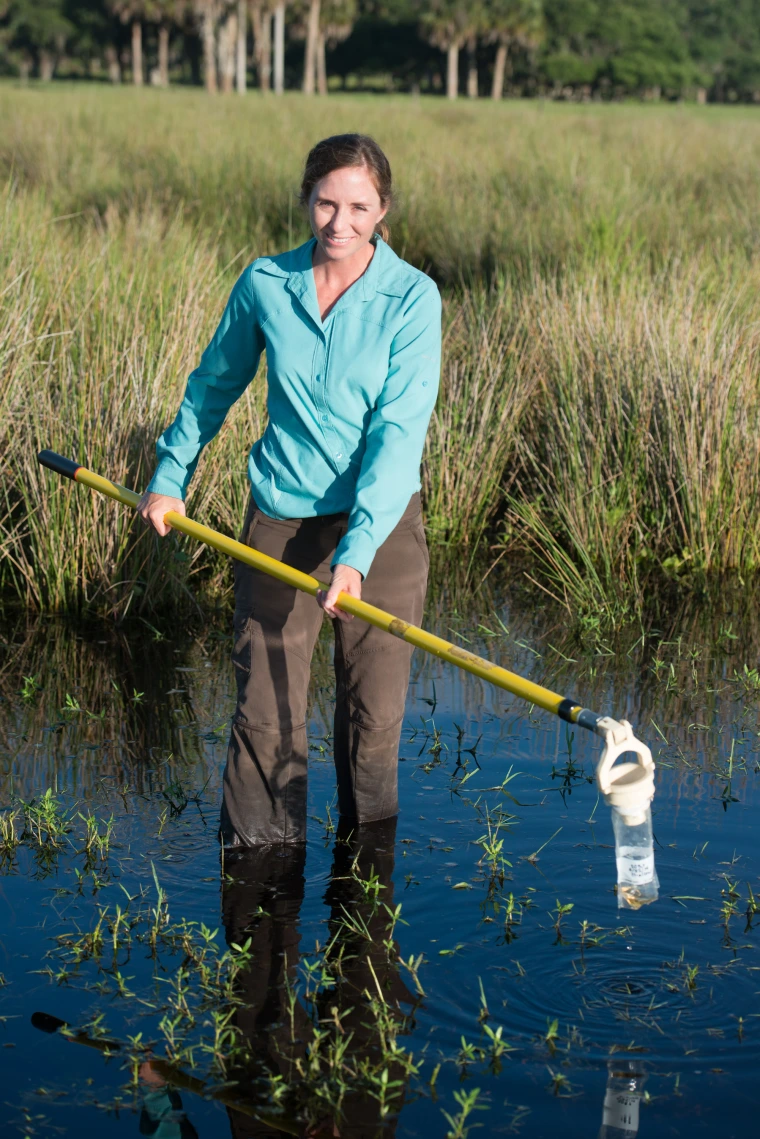
Besty Bowden: The grazing management is something that people have asked us a lot about, and there were times in the past when people are thinking about how to manage water and water quality in our watershed because the Everglades is such a low-nutrient system, and they're thinking of agriculture as a land use that adds nutrients. One of the questions was, like, what happens if you remove cattle from these landscapes? Would the water quality improve? One of the pieces of the earliest research projects that we did along with University of Florida and many of the state agencies that manage water in the environment, work together to design this experiment on Buck Island Ranch, where we tested treatments with no cows, and then low medium and high number of cattle for our land. We had experimental units with these treatments, and then we had arranged it so that each of the units had their own catchment area so we could collect the water coming off of each of these individual treatments and then test those nutrients.
Betsey Boughton: Most of the ranches in Florida. You mentioned, we have pastures that are planted with non-native forages. The one that we have here is Bahiagrass, Paspalum notatum, which is from South America. Then we also have these native pastures or semi-native, which are mixtures of our native bunch grasses and some of that bahiagrass mixed in. We actually had two pasture types within our study, with zero cows, low, medium, and high. One of the things that we found over this five-year study is that the number of cattle did not affect water quality. We were mainly concerned with phosphorus because that's the main nutrient causing eutrophication in the Everglades, and the Everglades is really low phosphorus. No difference in total phosphorus concentrations among those treatments, even the zero cattle, low, medium, and high, they all had very similar water quality. But the thing that did affect the total phosphorus loads was the pasture type. We had higher phosphorus coming off of those improved pasture systems. Keep in mind that this project went from 1998-2003. We hadn't used phosphorus fertilizer since 1986. This study was one of the first studies that pointed to a legacy phosphorus issue, that it was 14 years since phosphorus fertilizer had been used, and we're still seeing that legacy effect of that past fertilizer use. We saw very low phosphorus coming off of the semi-native pastures that had never been fertilized. Then we also had USGS scientists that came in, and they did a uranium study. Uranium is a tracer for phosphorus, and you can figure out how old that phosphorus is. Is it really old, or is it a fertilizer-derived phosphorus?
Tip Hudson: I've never heard of that. That's new.
Betsey Boughton: Yes. That study showed that 85% of the phosphorus that was detected in the water was a fertilizer-derived phosphorus. It really goes back to the type of soils we have in Florida. We have this soil type called a spodosol that about three feet down. It's all sandy, but three feet down. There's a spodic layer or a hard pan, clayish layer that has aluminum and iron in it that holds on to phosphorus. When our water table comes up in the rainy season, that spodic layer releases some phosphorus, and it comes up with the groundwater table. It's just because when we were fertilizing with phosphorus, it settled and leeched down into the spodic layer, where it got trapped. Then, when the groundwater table comes up, it brings the phosphorus and slowly releases it. It's really hard to manage that because it's so deep down there. Then it's related to the groundwater table. But overall, what that study showed is that removing cattle would not help that issue. That issue stems back from past fertilizer use. Then our next step in our ways of managing that legacy phosphorus issue was to hold water on ranches. This was possible because we have a lot of wetlands on our ranches, and we have ditches. We have over 500 miles of ditches on Buck Island Ranch. The idea is, if we can't change the nutrient concentrations coming off the ranch because of that legacy phosphorus issue, can we reduce the volume of water leaving the ranch and hold it on site so that we can increase plant uptake and soil sequestration of nutrients, and so that's when we started the idea of water retention on ranches. What we do is we block those ditches with water management structures, just simple boarded up weirs in the ditch that block runoff. With all of our ditches and wetlands, we're able to do that without flooding our pastures, and so we can maintain the grazing that we need for cattle. We can also provide these water retention services, which we can talk about how that evolved into a payment for water services program that ranchers can get paid for doing those water management services.
Tip Hudson: Yeah, let's do that. I'm just trying to envision this. The water is being held in the shallow ditches, but not inundating the pasture, so that you have anaerobic soil conditions in the active pasture. Am I hearing that right?
Betsey Boughton: Yes, that's right.
Tip Hudson: That doesn't cause other problems like denitrification or mosquitoes?
Betsey Boughton: I do actually think it causes denitrification. We see a big reduction in nitrogen in the water with this management practice.
Tip Hudson: Yeah.
Betsey Boughton: Probably what's happening is some of that nitrogen is being lost to the atmosphere by holding it on to the ranch. But it's good for water quality. That's where the trade-off- [OVERLAPPING]
Tip Hudson: Right, we even have nitrates.
Betsey Boughton: Then we didn't find any increases in mosquitoes. That was one of my projects that we did because we were interested in the trade-offs and the synergies of doing this water management practice. We didn't see any major increases in mosquitoes due to that, because we do have a lot of little fish that live in our waterways, so they're probably just having a feast on mosquitoes there. There is some loss of forage due to this water-holding practice. Because of that loss of forage, that's where the payment comes in. The water management districts, this is the state agency that manages the water in Florida. Our water management district is paying ranchers to provide the water services, with the idea that it's a watershed service. The ranchers are providing a service that's good for the entire watershed in the downstream ecosystems, and recognizing that they do feel some negative effects from losing forage that they are compensated for that. The state of Florida does put in these large public work projects called stormwater treatment areas that are very expensive and very management-intensive. They can only do so many of these type projects. If you get ranchers to install these projects, and if we had ranchers throughout the watershed doing these projects, it would be cost-effective and efficient, and a good way to provide some of those water services to the watershed scale. The program is called the Northern Everglades-Payment for Environmental Services Project.
Tip Hudson: What yield reduction is that in terms of forage? It seems nearly everybody that I've talked to has a stalking rate of somewhere on the order of 3-4 acres per animal per year. How much does that change? Or is it marginal enough that you wouldn't even characterize it that way?
Betsey Boughton: Let me see. On our ranch, we used to have about 3,000 cattle for 10,000 acres. It does work out to about three acres per cow. But now we're down to 2,700 head.
Tip Hudson: That's a marginal difference. What is the basis of payment? When the water management district is paying ranches for this watershed service, do they do that by the acre?
Betsey Boughton: Yeah, it's acre-feet of water stored. The way that they do it is they do a modeling exercise, looking at a 10-year period of record rainfall and calculating how much storage occurs with the water control structures in place versus what it would be with the baseline. That above-and-beyond change in storage is what they're getting paid for. It comes out to about 100-$200 per acre, which is pretty good.
Tip Hudson: Am I recalling correctly that Archbold is handling the monitoring for that program, on the ground management of it?
Betsey Boughton: Yes, that's one of the things my program has been doing since 2011. The water management district wanted to have a third-party verification monitoring team provide these monitoring services. This payment for ecosystem services project requires more intensive monitoring because this is taxpayer dollars that are getting used to make these payments to ranchers for water services. The buyers, or the state of Florida, the water management district, who are buying these water services, want to be assured and to have some evidence that the services are being provided. Because of that, we have a monitoring system where we measure water levels throughout the projects, and we also measure rainfall. Because rainfall is the driver of how much these projects store year to year. If we have a drought, then we're not going to be storing that much. But if we have a really wet year, then you're storing a high amount, and what we're getting paid for is the average. The ranchers that were involved in designing this program, they wanted to make the payment the same year after year, because that way, you could budget for it. That would just be a lot better and more sustainable than having these payments that fluctuate year to year.
Tip Hudson: Right.
Betsey Boughton: They wanted to have that flat payment. That's why they used the modeling with the 10-year period of record to get to that payment.
Tip Hudson: What are some of the other research that Archbold has been involved with?
Betsey Boughton: Related to improved grazing management, one of the basic things we did was just to build a series of grazing exclosures. Across our ranch, we have installed over 20 small grazing exclosures, and these are probably just 30 feet by 30 feet. They're not huge, but it was a way to show people what would happen if you removed cattle from the landscape. This was relevant because we have a lot of conservation easements in Florida, and some of the conservation easements allow grazing and some don't. What happens when you remove grazing is a very relevant piece of information for managing these lands. We have long-term grazing exclosures, and then we had University of Florida collaborators that looked at soil carbon inside and outside these grazing exclosures, and also how the plant community changes inside and outside the grazing exclosures. This is Chris Wilson. I think you talked to him before on your show.
Tip Hudson: Yes, we talked about carbon with Paige Stanley a while back.
Betsey Boughton: Chris did a study here and showed that there was more soil carbon in the grazed areas compared to these long-term grazing exclosures. There's more soil carbon and root biomass, and microbial biomass in the grazed systems compared to the ungrazed. Then, also with the grazing, it's a grassland habitat, so it's a grass-dominated pasture. But if you remove grazing, we see all these shrubs and forbs that aren't necessarily desirable come in. That's a really important piece, maintaining the grassland habitat, and even these pastures, which are non-native. Pasture grasses are really important for biodiversity and grassland birds in Florida. We have the crested caracara, the bobwhite quail, sandhill cranes, burrowing owls, eastern meadowlark. All of these grassland birds are really dependent on this open, short-grassland-dominated habitat. If you remove grazing and you get all these shrubs and forbs coming in, then those birds are not going to live there anymore.
Tip Hudson: How would you describe the patterns of growth and plant harvest by grazing animals that support that? Because obviously, I don't know, sometimes I feel these things aren't all that complicated. If in what I'm calling continuous grazing, at maybe a heavy stalking rate, animals are in the same pasture for most of the season or much of the year, you have re-grazing such that you never get this large pulse of growth. But there's 100 different flavors of what gets called rotational grazing. How would you describe the pattern of growth and re-growth that is the driver of the soil carbon, and maintaining this optimal mix of desirable plant species?
Betsey Boughton: We use rotational stocking here at the ranch. It changes throughout the year. If you're on a pasture or you're on a semi-native grass prairie.
Betsey Boughton: We really have a lot of growth in the summer in our wet season. When we're in the wet season, the cattle are rotating through like 20 days on and maybe 40-60 days rest. That's a high growth time period, and we do think that more intensive rotational grazing would help maintain the short higher quality vegetation during that time. If the forage quality or the forage nutritive value of these forages is really not that great, and it peaks in June or July and then declines, and so keeping it short and not allowed to grow too tall and get this poor forage quality is important. We try to manage that with the cattle rotations, and then we also use prescribed fire to manage forage value. We have these two. We have a little peak of growth in March when we usually get a little bit of rain in March, and then it gets really dry again in April and May. Then in June and July, we're just waiting for the rains to start, and that's when you really see another peak growth there.
Tip Hudson: By more intensive, you mean if you had your druthers, you would graze for a slightly shorter period of time and then have a shorter period of regrowth as well. Instead of 20 days on and 40-60 off, it would be more like, I don't know, half that or something.
Betsey Boughton: Yes, I think that would be ideal in the summer. But our issue is that we do get really dry in the dry season, which runs from about November to April, May. The way that our stocking is set is for the driest times. In the summer, we have a hard time keeping up with the forage. It's just hard to keep it short like that.
Tip Hudson: That seems like a good segue to the life cycle analysis carbon research that maybe is a little bit more recent that I think also involved Chris. Gene started to get into that a little bit, but he thought that would be a good thing for us to talk about, as well.
Betsey Boughton: We started working on the carbon cycle probably back in 2012, 2013, there was just a lot of, like our stakeholders were asking us, is the ranch a sinker source for carbon? Is there opportunities for ranchers to engage in carbon markets? We felt like we thought it was an important research question to address. We started out with lifecycle analysis with the University of Florida and we wanted to first characterize, understand the emissions of our ranch. We had all of our long term economic data, like how many cows do we have on the ranch? How much fertilizer do we use? Because we do use nitrogen fertilizer just sparingly, but not phosphorus. We also do fire. We use fire, we use tractors, we use the fuel, electricity, all that. Operations. We went into a life cycle analysis to understand the emissions. Then we came up with a number, and it was like 10,000 metric tons of CO_2 equivalents per year was the emissions that our ranch has. But then we knew that we'd like to look at the other side of the coin, which is what is our land uptaking? What are the emissions in the sequestration of our land. It's a 10,500 acre ranch, and we have 600 wetlands, and we have palm and oak woodlands, and then we have all these grasslands that we know are taking up carbon through photosynthesis. We did a back of the envelope calculation at that time, and we thought it was we calculated, making a lot of assumptions, but it was like 17,000 metric tons of CO_2 equivalents taken up by the land. Our basic back of the envelope understanding was that we thought we were a net sink. But we knew that with all of our wetlands, we would have quite a lot of methane emissions coming from soil. These are microbes that in the anoxic environment, the microbes are producing methane, as well. We didn't have a good estimate of that. It was a luck meeting, but we met with some researchers from University of Illinois and USDA ARS Agriculture Research Service. This is Carl Bernacchi and Evan DeLucia and Nuria Gomez Casanovas who's now at Texas A&M. They had some what they call eddy covariance towers, which are these really high resolution sensors that measure carbon dioxide and methane flux from the ecosystem in the atmosphere. They had five of those. They put them at the ranch. We put one in a wetland, two in improved pastures and two in semi-native pastures. Jed Sparks from Cornell as a longtime collaborator on this project too. We run those eddie covariance towers for they're still going. From 2013 now. Till now, 2025 was the last year. We started to get a much more refined idea of our ecosystem emissions and uptake. One of the things we found out was that the ecosystem, when our soils are wet are releasing more methane than our cattle. If you look at the methane budget of the ranch, the cattle are probably 30% of that. That was surprising to some people because they always thought that cattle were the biggest source of methane on the ranch, but it turns out to be the wet soils in the wetlands.
Tip Hudson: How did the net balance come out then?
Betsey Boughton: In the end, we had to do another model that used all this eddy covariance tower data, and it showed that once we had all this refined data, we are still a net sink of CO_2, and we're taking after we account for our emissions, it's 86 pounds of carbon per acre that is our net sink, that is.
Tip Hudson: Would that be higher, meaning a higher net per acre uptake if it was mostly upland pasture that didn't have much wetland? Is there any of that in the area?
Betsey Boughton: I don't know. It may not be because the water and the moisture that we have is helping these grasses grow in the pasture. If we didn't have all of our wetlands, we'd probably be in a drier system. I do think, I'm not sure what the answer is, but I don't want to come across as methane is bad because I think, wetlands are a natural source of methane, and they're part of our ecosystems, and wetlands are so good for biodiversity and nutrient cycling and just because they're releasing methane doesn't mean they're bad necessarily. We do think that wetland restoration and restoring hydrology is a good thing in overall.
Tip Hudson: Related to that, you guys have done quite a bit of research on individual threatened and endangered species, particularly bird species. What are some of the interesting species that you've worked on and what have been some of the results?
Betsey Boughton: I'm not directly involved in that research, but on the ranch, we've had long term research on Crested Caracara, which are very unique species in Florida. Most of their range is out West, but there's this little population in Central Florida and they're really dependent on the ranch lands. The research has just showed how important the ranch lands private ranches are for the sustainability of that population. If we didn't have ranches, we would probably lose crested caracaras from Florida. We've also had research on burrowing owls, which again, are really use private ranches as their main habitat. They're critical for the conservation of burrowing owl populations.
Tip Hudson: Quick question there. Why do you think they're primarily on ranches?
Betsey Boughton: I think because the majority of the Florida prairie is gone. We used to have this prairie region in Florida like in Central Florida. Most of that native prairie habitat has been converted either to urban or other more intense agriculture. The birds have used pastures as a surrogate habitat type, that the structure is the same. The plant diversity is different, but the plant structure is what they need for their habitat, and they like that short grass. There's some studies on reproductive success and foraging behaviors of burrowing owls and crested Caracara. They do use wetland systems a lot. We had little GPS backpacks on burrowing owls, and you could see them going to edges of wetlands and foraging around there. We do know that the crested caracaras are one of their main food sources is manure pats. They flip over manure pats and they're eating the beetles out of there. It's just like the resources that are provided by the ranch habitat are really important.
Tip Hudson: I have a totally almost unrelated question that just came to mind. Were there historically large herbivores in Florida before the arrival of Spanish cattle, besides things like deer, but deer, I'm not sure I'd consider large?
Betsey Boughton: There's records of, things I've heard, there were mammoths down here. There was Bison, some records of Bison, not as many, not as high numbers out in the Great Plains, but there were some stragglers that would come down. There's horse. Like, there's rivers in Florida where they're really good for fossil hunting, and you can find horse teeth and mammoth molars. We had, giant sloths that would burrow and, create these, wallows in the landscape. There are records of really large herbivores, but it was really from the Pleistocene, but still it was the vegetation has adapted to those disturbances.
Tip Hudson: I mean, while back on the ranch, I'm curious, what are some simple things that ranches can do to improve habitat value for bird populations, for example? Are there some obvious things that ought to be done that many people don't do that would be not terribly difficult in terms of ranch logistics that would make a difference.
Betsey Boughton: Well, the ranchers that I work with have been really good managers and land stewards. I think we've done a lot of work just understanding the ecosystem services and biodiversity value of ranches in Florida so that people are aware of those values and support the protection of ranches through conservation easements or other programs that help to keep ranchers ranching. I think one of the things to keep doing what they're already doing and to maintain their landscape mosaics of, a mix of improved pastures and the semi-native pastures, because the improved pastures provide the short grasses that a lot of birds need. Then the semi-native, which are taller like bunch grasses, that structure provides other habitat values. Trying to keep those two land use types, because most ranches have that mix and we don't want to see it tip the balance to all one type or the other. I think the mix is what's really important. I think rotational stocking, like in any way that works for the ranch is a good thing because then you do get some amount of rest and having prescribed fire in a variety of seasons and spatial scales will be beneficial because just having those different habitat structures available, like the recently burned vegetation and the long unburned and different seasons, just very important for different flowering plants and maintaining the pollinator habitats. Just like, as much diversity as you can create on your landscape. We've done some work with incorporating legumes into pastures, and we do note that that is improve soil health and observationally improves pollinators because with the legumes, you get a lot more of the flowering resources.
Tip Hudson: You mentioned way back when we talked several months ago that the research coming out of Archbold has value more broadly than just South Central Florida primarily because there are a lot of places in the subtropics and tropics that have this similar bimodal precipitation pattern where you don't necessarily have winter and summer, but you have dry and wet, and there are lots of places with that subtropical pattern with similar vegetation resources. I think you mentioned that some of this would be relevant in Brazil and Northern Australia, and parts of Africa. What have been some of the outreach efforts to, and to what extent are people in those places paying attention to your research?
Betsey Boughton: One of the ways we were able to connect with Australia and Brazil is through our work with Alltech, which is a nutritional feed company. We work with Alltech quite a lot on the carbon cycle research, and just with, understanding the value of ranches for conservation and ecosystem management, and Alltech was really into trying to tell that story. Storytelling about the value of agriculture, not just for food production, but for multiple ecosystem services. Because Alltech, which is a private company, works in these different places, then they were able to connect us with them. We've had people tour the ranch from Brazil, Australia, and we've shared our carbon research with those in Australia because they were very interested in that. I think it's just interesting because ranches and cow calf and grazing cattle in general are seen as bad for the climate and producing a lot of methane. We're trying to bring a more comprehensive story to that, not just focusing on that one thing, but recognizing that there's all of these other values to the ranch story, and that we're collecting data on it, and we have the data to show the evidence and the proof of these things. It's not like we're just talking about it. I think the data and the evidence is really important, and there's not much of it around. When you can show the data, then people get really interested. I do want to mention the long term agro ecosystem research network that's funded by the USDA Agricultural Research Service that we're part of. Archbold and University of Florida using Buck Island Ranch and our other ranches in the region, we're part of that LTAR network, and then our data goes into these large national databases on the role of agriculture and how we can maintain productive agriculture at the same time as trying to maintain some of these environmental values is something that we're all working together. With an LTAR. Most of the LTAR grazing land sites are arid or semi-arid or in the Great Plains. By having Archbold and Florida in it, it brings in that subtropical humid perspective that then makes the LTAR platform even more relevant globally.
Tip Hudson: What data is being collected through the LTAR?
Betsey Boughton: We're collecting some of the basic metrics like productivity, forage, growth, forage yield, forage quality, soil carbon, and beef production. Then all of the LTAR sites are implementing an experiment called the Common Experiment, where we're comparing a prevailing practice versus an innovative or aspirational system. The ideas to serve as a test bed to see if there's any innovative practices that we can incorporate to improve productivity, improve efficiency, or natural resource management, compared to the prevailing practices of the regions that we're in.
Tip Hudson: Is that a treatment or a treatment protocol that changes periodically, but changes across all of the LTAR stations? Is that what I'm hearing?
Betsey Boughton: Yes, it changes periodically, and we tailor our treatments that we're testing to our region. In Florida, we were testing patch burn grazing, which is burning small sections and rotating fire around. We were also testing this legume planting treatment. In New Mexico, for example, they're testing heritage genetics versus traditional genetics. Then in Colorado, they're testing collaborative adaptive range land management versus just continuous grazing. Each region is trying to address the needs of the regional stakeholders. Then by being in the national network, it's giving us a national view of grazing lands as a whole. The interesting thing about LTAR is that we also are making a concerted effort to work with the stakeholders and understand what the stakeholders need, and getting stakeholders to co-produce the research with us. It's hoping with the knowledge that that research is going to be more relevant and more easily adoptable if you are incorporating stakeholders into the research process.
Tip Hudson: I think I just have two more questions. One, I wanted to ask about the Florida Wildlife Corridor, and then we can end with what does the public outreach from Archbold look like? You guys do quite a few in-person events, tours, some K through 12 education. But first, tell me about the Florida Wildlife Corridor. It feels like a panther could make a living out there because there's so many places to hide, but it feels like it'd be more difficult for a bear.
Betsey Boughton: The Florida Wildlife Corridor is an idea or a conservation strategy that is identifying a geography that's a priority for conservation, and it's incorporating the need of the connectivity for some of these large-ranging animals, like bears and panthers. It's understanding that you can't just have all these, fragmented, isolated protected areas. You actually need them to be connected to have a functioning population. In Florida, there is still opportunity to have a connected corridor from the Everglades to the Panhandle. In part, it's due to our private ranches. The ranches are about 40% of that corridor strategy and geography. It goes through the center of Florida. It's like the least populated areas of Florida. It came about from some work from University of Kentucky, but also Archbold scientists that work together to do a GPS collar tracking of different bears that are in the region, and by putting the GPS collars on the bears, they could see where these animals were moving and what are the corridors that they're using. This bear that was trapped, this was the M34 bear, and there's actually a big story map on it. That's on the Archbold website. It's really cool. They trapped the bear near Buck Island Ranch in Archbold, and they noted how the bear moved all the way up basically to Disney World. That's like 120 miles north of here. Then there was a big highway called I-4, and the bear stopped at that highway and said, No way. Then it turned around and came back down these corridors, and you could see that it was using private ranches and also public lands, so the matrix of private lands and public lands to make its way through the landscape. We had conservation photographers, Carlton Ward and some other really good storytelling that told the story of that science and really helped to get momentum around it and support from the policymakers that we had the data, we had the charismatic images and the stories, and then it was passed as a Florida Wildlife Corridor Act in 2021. With that policy support, then it just gives all this support for purchasing conservation easements and making a planned conservation approach to protect these corridors. The conservation easements remain in private hands. That's one of the good things about a lot of these conservation easements. It keeps ranchers ranching, but their land is protected in perpetuity.
Tip Hudson: That's very interesting. It sounds like some similar efforts in the West. You just have a slightly smaller landscape there, but I think bigger than people often realize. There's quite a bit more open in Central Florida than what a lot of people envision if they've just traveled the coast. Does the Archbold Station take visitors, and what does your public outreach program look like?
Betsey Boughton: We do take visitors. We have some educational programs where visitors can come to Archbold, and we have some trails and educational trails that are marked with signs that visitors can come on. The ranch, we do swamp buggy tours. We have this big buggy that is a homemade project with F250 [LAUGHTER] bones, and then it's like a big platform that a lot of people can sit on. We do tours of the ranch, but it's appointment only. But we do at least one or two every month, and we have like field days, and then we have these public events, especially at this time of year, when it's nicer, cooler weather out, we have a lot of different public events where we invite people and do these activities with the general public. We have a scrub camp that's for six-year-olds to 11-year-olds in the summer. That's their week-long day camps where kids can learn about the Florida scrub, and they do go on a ranch tour, so they get the agro ecosystem tour as well. We try to do education as part of our mission. We're a research, conservation and education organization. Those three pillars part of our mission, and we do try to do a lot of different types of education for different parts of the population.
Tip Hudson: It's an impressive landscape and impressive facilities, and quite a prestigious history. Congratulations on the new position. I would ask if people are interested in learning about some of the research that's been done there, much of that is on your website, is it not?
Betsey Boughton: Yes. It's on our website. We also have social media, so people [LAUGHTER] can find Archbold Biological Station on Facebook and Instagram and LinkedIn. That would be great.
Tip Hudson: Well, Betsy, thank you for your time. We will put some of those links in the show notes and encourage people to listen and look, and maybe come visit.
Betsey Boughton: Great. Thank you, Tip, for the opportunity to share. [MUSIC]
Tip Hudson: Thank you for listening to the Art of Range podcast. Links to websites or documents mentioned in each episode are available at artofrange.com. Be sure to subscribe to the show through Apple Podcast, Odd Bean, Spotify, Stitcher, or your favorite podcasting app so that each new episode will automatically show up in your podcast feed. Just search for Art of Range. If you are not a social media addict, don't start now. If you are, please like or otherwise follow the Art of Range on Facebook, LinkedIn and X, formerly Twitter. We value listener feedback. If you have questions or comments for us to address in a future episode or just want to let me know you're listening, send an email to show@artofrange.com. For more direct communication from me, sign up for a regular email from the podcast on the homepage at artofrange.com. This podcast is produced by CAHNRS Communications in the College of Agricultural, Human and Natural Resource Sciences at Washington State University. The project is supported by the University of Arizona and funded by sponsors. If you're interested in being a sponsor, send an email to show at artofrange.com.
Speaker 1: The views, thoughts and opinions expressed by guests of this podcast are their own and does not imply Washington State University's endorsement.
Archbold Biological Station website
Cowboys and Scientists: https://youtu.be/y6_WhY3aZB0?si=ExCUf1Oga0Y2s9SV
The Science of a Florida Ranch: https://youtu.be/rGV_G6dnYHg?si=ehivHvhWgXiUqHUi
Understanding the Carbon Cycle on a Cattle Ranch (Alltech): https://www.youtube.com/playlist?list=PLVUUdObpd0zi93eJrqtoUrxolITesaRjV