

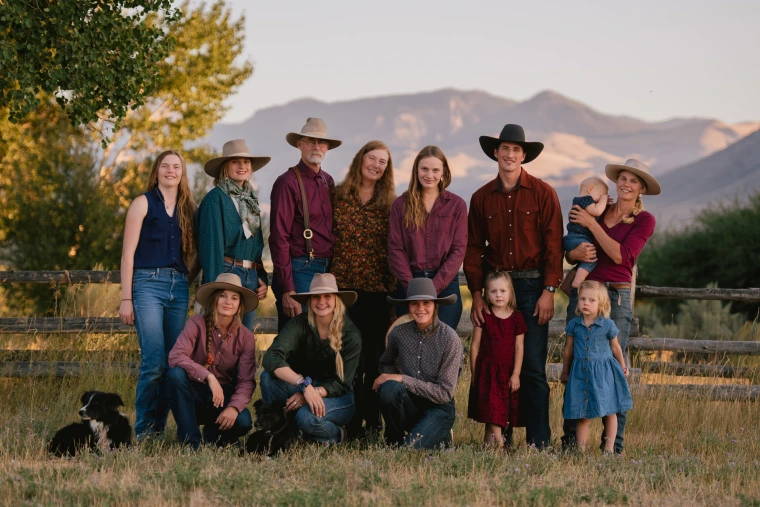
Storytelling, direct-to-consumer beef sales, animal behavior, grass taxonomy, beavers, water, and wolves. Glenn Elzinga has tried to tackle it all raising cattle in the Pahsimeroi Valley and nearby mountains of south-central Idaho. Alderspring is a 100% grass-fed and certified organic ranch that’s been raising cattle on wild rangelands for over 30 years. Glenn, Caryl, and their seven daughters use herding movements they call 'in-herding' to optimize grazing effects as part of a healthy ecosystem. Glenn maintains a colorful ranch blog where he tells many of these stories.
The Art of Range Podcast is supported by the Idaho Rangeland Resources Commission and the Western Extension Risk Management Education Center.
Music by Lewis Roise.
Transcript
Tip Hudson: Welcome to the Art of Range, a podcast focused on rangelands and the people who manage them. I'm your host, Tip Hudson, range and livestock specialist with Washington State University Extension. The goal of this podcast is education and conservation through conversation. Find us online at artofrange.com. My guest today on the Art of Range is Glenn Elzinga of the Alder Spring Ranch in southeastern Idaho. Glen is no stranger to a microphone, and part of what we want to talk about is his willingness to be pretty transparent about their lifestyle and the seasonal rhythms of caring for animals in a picturesque but challenging environment. Glenn, I feel like our paths must have crossed at some point, and your face looks familiar, but I don't actually know that we've met, but welcome to the show, even though we can't see each other.
Glenn Elzinga: No, I think we have met. It's invariable. We do live in a little bit of a vacuum in the Northwest. I'm talking about Washington, Oregon, and Idaho. It seems like there's a lot more going on in other places. California is a hotbed of these discussions. I just came out of Colorado, Arizona, there's a lot going on, Montana, there's a lot going on, but for some reason, our three states in the Pacific Northwest, it's a little bit lower key. There's a lot of great conversations going on, but there's not a big conference circuit or anything like that going on. I think it's the nature of the geography tip. We have these huge mountain ranges that cause extremely divergent vegetative types and land practices. West of the Cascades, obviously, it's basically rainforest and then the rain shadow of the Cascades. You become this incredibly brittle desert environment, and it's similar in Idaho. We have northern Idaho, which is very much swung by maritime influence, and then we have the dry Intermountain West. We're basically in a basin and range setting very similar to Nevada. Then things even out in Montana. I think that's the geographic dissection of those mountain ranges to cross, and the polar differences in each of our three states between one part of the state versus another. As a result, there's not a lot of continuance and consistency in conversation there. It's just an interesting demographic.
Tip Hudson: Yes, it is. I mentioned that you ranch in a picturesque location. These are the places that we put on postcards, and it's also challenging. Describe where is your ranch and how did you come to be raising livestock in that part of the world?
Glenn Elzinga: Our ranch is in high Possum Valley, and I say high because Idaho is on the southern tier of the state is encompassed by this thing called the Snake River Plain, which is just this huge curve starting all the way in Yellowstone Park, and it goes then south and then southwest and then straight west all the way across the southern tier of Idaho toward Boise where it connects with Oregon near Ontario, Oregon. There's this huge continuance of ecotypes across Snake River Plain, a lot of basalt plains and extensions of Lake Bonneville out of Utah. Geographically, it's not monotypic by any means, but there is a lot of similarities, and topographically, it's not dissected by a lot of mountain ranges. Then you move out of that geographic province, and you come into this basin and range country. If you look at a map of Idaho, it looks like a grizzly bear scratched his claw across Southeast Idaho to gouge out five parallel mountain range systems. It's a miniature emulation of the Basin Range province of Nevada that's here in southeast Idaho. We're at the top of one of those trenches, and we're stuck between Salmon and Chalice, Idaho, in this remote valley called the Pisimi. It is higher than the Snake River plain, and it tilts up away from the Salmon River, which drains all of those valleys. It's a weird province because we have these broad valleys. My valley is about 15 miles wide and about 55 miles long, and they're bordered by these 10, 11,000-foot mountain ranges. You're right. It is very picturesque, but that just by definition creates a brittle environment because basically, all that maritime influence moisture from the Pacific gets screened out pretty effectively by those mountain ranges, and we end up in these dry valleys, and we have a lot of dry rangelands, of foothills to those mountain ranges on which we graze cattle. It's basically the equivalent of cold desert just like it is in Northern Nevada and Northern Utah. We have an extremely unusual monsoonal flow. It happens maybe once every 10 years, whereas I have a lot of friends who graze in the southwest of Montana and Arizona, and they have a pretty consistent monsoonal flow. That Monsoonal flow means you get water during the growing season, and we really don't get that. That's very unusual. That's what makes it a cold desert, and that's what makes it a unique ecosystem in which to graze on because our plant composition is different. We really have no warm-season grasses at all, and it's all cold-season bunch grasses, predominantly. They can be very, we call them decreasers categorically. That's what the botanists and plant ecologists like to call them. They say these are decreasers, and it's because bunch grasses are predisposed to decreasing from continuous grazing. But anyway, how we landed here was that I was a timber guy in the Central Idaho Mountains for the BLM for 15 years. Carol and I wanted to have a family, and we wanted to go back to our roots in agriculture. She was brought up on a farm in the Midwest. I come from probably 1,000-year history of dairy farming in northern province of the Netherlands, known as Frisland. We got out of that when I was a tiny little kid, and my dad was like, there's no money in this, and he quit. I was pretty much out of it for all my life. But I think it was running through my blood. Always wanted to get back into cattle. I just didn't want to get back into those spotted cattle that you got to squeeze twice a day to get milk out of them. I wanted their babies to do that. We bought a small ranch in I think it was '92, and we made a go of it. We thought, very ignorantly, well, anybody can make money into cattle business. It doesn't seem very hard. Boy, we had a quick study there and had to learn how to make it. We bought seven cows on 60 irrigated acres at first, and we thought, oh, we'll just expand this, and we did. Thank God we got through it all, but it wasn't without fantastic mentorship. We just had a lot of old ranchers who took us under their wing and really got us a reality check about how to do it. I also had some really good financial folks that got us going. But anyway, the rest is history, and now we've had this thing, this has been 33 years, and we're profitable. We're quite a bit bigger than that seven cows on 60 irrigated acres.
Tip Hudson: You're selling much of your own meat. What does the operation look like now? Even trying to do direct marketing is quite a difficult business to run.
Glenn Elzinga: No, it is Tip. It is really tough nut to crack, and we started that out of desperation because we weren't making it on the commodity market back then. [LAUGHTER] Like these CAP prices right now, it's wild the differences we've seen in our life; we were getting $0.75 for calves. Of course, we're losing money hand over fist. But you could buy a mama cow for 300 or 400 bucks. Now multiply those things times 10. Not quite the calf prices, but the cow prices, certainly. You're looking at calf prices. I got neighbors getting four bucks a pound for their calves today. Of course, that didn't happen until very recently. As a result, we had to come up with an alternative marketing scheme, and that was to cut out the middlemen and try to find a way to directly connect with the consumer. Back when the Internet wasn't cool and back when grass-fed was an unheard-of term in the early 90s, we launched an online business. We've been at it ever since. Right now, it's a seven-figure business, and all of our production goes there. We're on a total of 49,000 acres between leased ground and private ground. Like I said, we're cash flowing, and we're profitable. We're still in some debt, but we've really made great progress on it. We're feeling pretty damn good about that. But now our cattle herd is we have both mama cows and our finishing herd. In total, we're sitting around, oh, it depends on time of year, of course, but we're sitting around 6-800 head, usually. It's grown up a little bit since that seven-cow humble beginning, but it's been pretty much an organic, no pun intended, way to get there, because we just built on that original seven cows. We took out some money to get some more. We just scaled the thing up, and we did it in a way that wasn't going to bury us financially. There were some really tough times, Tip. I won't belabor that, but I will just say, in the mid-teens, there was a price blip, then we're buying feeder cattle from people, other organic grass-fed producers, and bringing them on our deal and finishing them here. Boy, it was really adverse because we were in the hole pretty bad with those high prices. Now we've managed to dig ourselves out, and thank God that's behind us. It's tempting to say, oh, we could scale up now. But on these feeder prices, we just can't cash flow with the price right now. Even though, in terms of what the money is, the bottom line in terms of what goes in our pocket, right now, it's basically a wash between the two, between that high commercial market and what we were getting direct online. We're feeling okay about it, but it's still like, why are we doing all this work when I get these buyers saying, hey, Glenn, you want to sell your calves? [LAUGHTER] It's pretty tough to say, no, we don't want to sell our calves. They're like, no, you don't understand. I'll give you 450. It's like, that sounds pretty good. But, Tip, the bottom line is, what the heck are you going to do with the money? You know what I mean? Who cares? Maybe buy a new pickup instead of the old ones we drive, maybe buy my wife some new windows that don't leak as much. It's just at this point in your life, when you're 60, it's like we got everything we need, and in fact, you get to be in this mode of we don't need that anymore. Let's get rid of it. It's just a really different mindset when we're accumulating. I'd go to a ranch sale or something like that when I was 30, and it's like, I need that, and you'd be grabbing all this stuff. Now, it's like, I feel like having a ranch sale, just to get rid of all the junk I don't use.
Tip Hudson: That's a good point. One of my questions that I was thinking of for later while we were talking was something that a colleague asked me a little while ago, what motivates you to get up and work hard every morning? I'm hearing you saying that accumulating more stuff is probably not that thing.
Glenn Elzinga: [LAUGHTER] No, you're right. You're absolutely right. I'll tell you a little funny story. I was actually going to write about this in my blog, maybe. There was a FedEx guy who came by last night, and he's wearing a FedEx uniform, and he's a young man. He looks like he's in good shape. FedEx drives its employees pretty hard in this country. They go to cover a lot of miles, and a lot of times they get to walk through deep snow, brave dogs, mean dogs, and all this stuff. I shook his hand, and he just needed me to sign it. For some reason, I'm a very visual person, and I'm always running these scenarios in my head. I'm on the back, and I'm loading tun bales onto a flat bed because we're going to go feed. It's later than I like to feed. We like to feed in the mid-afternoon, and it's probably pushing around 5:00. The sun is thinking about going down, and he hands me this thing to sign. In my mind's eye, I'm thinking, he's going to ask me how can I get to do this? It's getting cold. But I'm like, wow, this place is covered with beauty. We're going out to feed those cattle. I love being out with our cattle and just watching it hay tumble down. We just started feeding a little while ago because we've had a wonderful green grass explosion because we've really built soil biology like crazy. As a result, even through January, our grass was still growing, and we still had green. Even our finished cattle just started hay yesterday. I was just so excited about being here and being able to go out there. I just thought, this guy is wondering how he can do this. Obviously, he just wanted my signature. But I just thought about it, and it's like, why wouldn't everybody want to do this?
Glenn Elzinga: Because we're out there on the land, we get to see this beautiful country. We get to see these cattle grow off these wild landscapes. We interact with all these wild animals every day. We get to see stuff like soil biology that we've never had before, that's creating resilience all around us. There's a storm happening all around us, and it's a good storm. Last year was the driest year we've ever had on the range. It was the driest year. I bet our effective precipitation in the low elevation stretches range was no more than two inches for the entire year, and yet we ran a grazing program on that landscape, and we were very successful. We still pull off like a pound and a half a day off of our yearling cattle off a very dry and brittle landscape. Those things really all excite me. Those are things that really get me excited in the morning. I think there's a second part of it. The second part of what gets me excited in the morning is getting to tell other people about it. That really gets me going because I just feel like I'm an optimist. My wife says, you are an incurable optimist. I just feel like there's so much hope in agriculture right now. I saw you had Gabe Brown, Mathew Joe, and that guy just speaks hope. He just speaks hope. If we could just embrace the principles he's talking about and think regeneratively, I'm already seeing. I've been at this for hardcore regenerative for probably 12 years. I just see results, Tip. I just see results, and it gets exciting, and it causes us to be profitable. Of course, making money is fun for everybody. But more so, I get to see that you got a heritage from the land and a ranch, and that's our past that we're building on. But then we got this legacy. Legacy is what goes beyond us. What's exciting about that to me is that I can offer hope to that legacy. I can tell my kids, hey, I want you to stay on the ranch. If you want to stay here, I want you to stay here because I see total and complete hope in this type of agriculture, because we can not only build on this biodiversity, but we can also stack enterprises. We can gain higher stocking rates on ground that we've never been able to do before. We can see that range paying us in spades in terms of nutritional quality that is even medicinal to our cattle and even ultimately medicinal to us in terms of what it can feed us in terms of nutrition, that's unmet by any other venue on Earth in my mind, because we're basically consumers of wild plants and wild protein that are curated by our cattle. These opportunities are just so extensive, and it's really exciting to participate in some outreach, Tip, and tell those stories. I speak to a group of Blackhat ranchers, and maybe it's 150, 200 Blackhat ranchers in South Dakota or something like that. Tip: if I could just gain the eyes and gain the interest of five of those people, I've won. That's an exciting thing because when I see those eyes make contact with me, I see that they've embraced that there's possibility. Because we hear so often that agriculture is hopeless and lacks possibility for the future. If I can convey that word of possibility to people, I get really excited, and that's what gets me up in the morning.
Tip Hudson: I love that. I do work for Washington State University, and I had my annual review a few days ago with my supervisor. One of her questions was, what does the best day of your year look like for you? I think my answer is a little bit similar to yours. When I'm speaking with people, and I can tell I've got their attention, and you create some an aha moment where they see some thing in a different way than they did before, and it provides some hope and some optimism about the future. That definitely excites me. I sometimes call myself a hopeless optimist, or my wife calls me that, which sounds a little bit like an oxymoron. I think I like incurable optimist better, so I might adopt that for myself.
Glenn Elzinga: I do understand hopeless because my wife tries to bring me to the ground, and she's likes you're hopes hopeless.
Tip Hudson: It's realism.
Glenn Elzinga: Yeah, exactly.
Tip Hudson: Well, because I'm a range nerd, and I'm always trying to learn about the various management approaches that people use in different contexts, I do want to get around to talking about your grazing management, but I think it might be more interesting to stick on the track that we've begun and talk about your efforts in communicating what you do to people outside this range nerd circle of wagons, because we often say that ranchers need to tell their story. There are some pretty impressive efforts out there, like Idaho's Life on the Range series, that are well done and that do reach people. But we still don't have very many ranchers that are writing blog posts and speaking and actively doing this, I think, really hard work but satisfying work of outreach. I don't know, communication sounds like an awfully sterile word, but I'm not coming up with anything better. What got you to start doing more of this communication or telling your story, which sounds too cliche? You tell me what you call it, and why you do it?
Glenn Elzinga: I think I just call it storytelling.
Tip Hudson: Yeah, I like that.
Glenn Elzinga: It's because, Tip, I'm a forester by training, forest ecologist by training. But I think it was that ecological background that helped me connect a lot of the dots on the range. I was arguing with my wife today about Bluebunch wheatgrass because I said, these taxonomists drive me crazy because they've changed the name now to Pseudoroegneria spicatum. She said, "No, it's not spicatum. It's spicata." She said, Pseudoroegneria spicata. I was like, whatever. I used to be spicatum because agropyron before. I love those plants, but I don't know them. I had a skeletal knowledge of them, and I'm trying to just throw flesh on those bones as fast as I can. I can't learn fast enough, Tip. I never thought I'd be learning. I think I'm learning more now on a daily basis than I was when I was in universities in my 20s. It's just inconceivable that it's a different learning because I have this framework, and now I'm just trying to throw flesh on it. I got this huge grid in my head, and I'm just trying to hang tags on places of the grid that I already have, and I'm just filling holes in it now. That's really an excitingly different way to learn. I think it's partly what we call wisdom because we've developed this whole framework of how we think, and now we can hang all these things on it. That gets really exciting to see that happen. Anyway, I think I would go back to storytelling because I'm not a plant educator or necessarily a range ecology educator, but I can tell you stories that have moved me, and that's what most of my blog is. I think we got started there because I just hated selling stuff. We sell our beef online, and I hated writing sales copy or saying, you need this for your health, or this looks good on your grill. Those are ludicrous things to say. I remember I had a friend of mine who was a car dealer. We talked about salesmanship and the way he was trained, he was trained in a family car dealership. What he was expected to say when somebody sat in a car that he was trying to hard sell them, he'd say, "Man, that car looks good on you." Some people would buy that stuff, but in today's world.
Tip Hudson: It turns me off.
Glenn Elzinga: No, it's a complete turn-off, and it's a complete turn-off to most people. It's because we've seen marketing. I think when I was researching marketing, even 10 years ago on social media, it's like, you got to reach somebody 14 times. I think it's more like 24 times now, Tip, that you got to reach somebody with an idea 24 times to convince them to even crack open a page and determine whether or not it's worth pursuing. That stuff just turns me off. But what does turn me on is telling the story. That's maybe the story about just how we raise our beef. But for me, it's become much more important than that. It's become telling a story of life on the range that's this connectivity. We used to be in a place of we're acting on an ecosystem. We got this rangeland ecosystem, this high sagebrush biome that moves into coniferous interaction biome as we gain elevation. We used to think about that ecosystem and what are cows were going to do to it or how we're going to mitigate that cow use. Instead, I shifted gears into how can we become a functional part of that ecosystem. How can we replace something that's not there anymore, like occasional grazing by bison, or there used to be these very large herds of bighorn sheep here, and emulate their grazing patterns to reconstruct the functionality of an ecosystem? Instead of being these agents that act on an ecosystem, I wanted to take people to a place where we function as part of one. This whole wolf thing that we got sucked into by Fish and Wildlife Service fighting with Idaho about wolf recovery and all these things really brought it front and center because I realized I really need to change the rhetoric in my mind about who and what the wolves were about. Granted, they haven't been part of that ecosystem for some time after getting pretty much extirpated. They weren't completely wiped out in Idaho, and that's why the Fish and Wildlife Service said, "You're a recovery state instead of a full-on re-establishment state." Because there are wolves here the whole time, either from Canada. We had some locally here in the wilderness. Fish and Wildlife said, "Hey, you got to restore these wolf populations." But basically, the wolves and our cattle on the ecosystem are new parts of the ecosystem that were meeting a niche that was there prehistorically. Ours in terms of occasional bison use, bighorn sheep, basically native grazers, and native grazing patterns. The wolves, now reinstating them into their position, were this predator that also had functionality and ecosystem prehistorically. That's the way I need to think about the wolves differently and say the wolves are here today, and we're going to figure out a way to coexist with them that's non-adversarial. That's where the storytelling really went. It was a whole different setup on the ecosystem, and it took me a lot to get there with the wolves because the wolves were an adversary. I just wanted to kill them all when they first showed up. I was very angry at that time because they were going to take away our livelihood. There was three, four-year period where we lost about a total of $100,000 worth of cattle to wolves. That on today's dollar would be around $0.5 million. At that point in time Carol and I, my wife, we looked at each other at the end of one of those bad grazing seasons and said, we can't do this anymore. This is economic suicide. The wolves were going to wipe us out. We're quite angry at that point in time. But it wasn't until that we thought things in terms of what the story was in our own minds of how we fit into this ecosystem, and how we could become part of it. That's what the storytelling has become. Generally, that's been received really well. I get a really strong following in that, and it's because it resonated with people. I think that's who we are, Tip. It's who we are, and it's how we were made. We are designed to not be just agents acting on an ecosystem. We're designed to be agents that are part of an ecosystem. I see it, just to give you a little example, we bring a lot of interns on every year, and at the end of their internship, last year we had 19 of them from all over the country, young people. They come here, not sure what they're looking for. Some of them come to find themselves, whatever that means. But they do see us as cattle grazing on rangelands and being an extractive mindset. But generally, I think, they leave because now they actually after living up there and camping on the ground and sleeping with the cattle every night and having wolves nearby, you can hear them howling at night sometimes.
Glenn: They have changed years, and I think in their mind, they realize that we are now part of this ecosystem. We're not just taking from it. We are now giving. It's a give-and-take relationship where we're part of it instead of just extractive. That's the thing that I'm portraying a story. It resonates, and actually, I think people respect that. I do think that's why a lot of people have partnered with us on a ranch in terms of being our customers. We sell out of our beef every two weeks. We get fresh beef in every two weeks. That's why we sell out of it. It's because people realize that this is something much bigger than just buying beef from somebody. They've connected into the wellness pathway, with these 2,200 native species that are up on that range, and these animals graze in a phytochemical diversity. They feel better on our beef. There's all those connections, too, but they all align with the story of that ecosystem.
Tip: I'm hearing in what you're saying, even what I think is a communication strategy for conflict, which is to identify with people's feelings, and beliefs, and experiences on all sides of the conflict. Wolves and you're dealing with several divisive issues, meaning that divisive in a way that they can actually split the ranching community into different camps. Wolves is one of those regenerative agriculture, and however we define it as one of those trying to sell grass finished beef or various grazing philosophies can be divisive, and I think to use another overused term to talk through what your journey has been is a good way to do that. Regarding wolves, how do you deal with them now that's different than you did then when you had the heavy losses?
Glenn: We didn't deal with them when we had heavy losses. They just dealt with us [LAUGHTER]. They was spy on us, strategize and stalk and kill [LAUGHTER]. That was a very simple predatorial strategy that they employed. It's been around since time immemorial. It's been around for a millennium. What we did was, that painter Charlie Russell, we saw a bunch of his paintings one winter. He's a chronicler of this high plains, high prairie methodology of running cattle. They herded their cattle. They kept them all in a bunch. They lived with their cattle 24/7. The reason they herded them and lived with them was because of rustlers finding good grass, keeping him off bad water and bad grass that was toxic in some form or another. They kept him safe from predators. Most of those things, even the rustler thing at today's cattle market, they're all real. The parallels were pretty synonymous between what they were dealing with and what we were dealing with, especially with the war intervention. We adopted that strategy, we said, "Let's just go live with the cattle." What's crazy about it, Tip is because we're actually more strategic about her grazing than we'd ever have been. Once we started herding them. We realized this full cattle control enables us to do what those early plains grazers did. We took them to the best grass. We actually thought about what their diet looked like. A lot of that segued off a book that I read that was edited by Dr. Fred Provenza from Utah State University. It's called The Art and Science of Shepherding. I found that book one day, and I just devoured it. It was because this was what I was looking for in terms of how can we parallel these ancient stockmanship and stewardship and shepherding principles and put them on our modern-day rangeland. What we do up there, going back to your question about the wolves, it's really simple. We just got a human presence with these cattle 24/7 and that scent and the essence of that presence is enough. Because of that, we haven't had a wolf eating our cattle for now, I think it's been 12 or 13 years, we're at zero losses. What was crazy about the whole idea is that we stopped losing cattle to things like larkspur, other poisonous plants. We have a lot of death canvas up there. They didn't fall off cliffs anymore. We didn't end up with just attrition loss, where they disappeared. We didn't know where they went. Maybe some other person picked them up, and they didn't have a good brand on them, and they became part of the calf crop. I don't know. there's all kinds of things that cause us to be losing 3-4% of our cattle, even before wolves every year. Now, most years, it's unusual that we don't come back with 100% of our cattle that we put up. All those losses stopped, incredibly, poisonous plants like larkspur, all that stuff stopped, and it stopped because now we had full control of cattle, and we basically were planning their grazing every day. If we saw larkspur, we'd happily graze it Tip, but it was about how much utilization of the preferred species we were seeing. Our main goal in grazing up there is to try to take only 40%. It's not 40% of the grass. It's 40% of their solar panel, especially early in the season because we want to leave enough of a solar panel out there because that photosynthate, those sugars produced through photosynthesis, if we eat that whole solar panel, we're going to end up short on those sugars. In these cold desert plants, that spring flush is all you get. It is all you get. It doesn't matter whether or not you have late-season rains. You're usually going to have a plant that has now nest and is in dormancy, very low likelihood for it to take off. The other part of our ecosystem up there is that in our country, not every year is a good year. In fact, maybe half of the years would be fair years, and the other half would be pretty dismal year. I told you about this summer, how we were two inches or less in some of the low ranges in terms of effective precipitation. It was because in the springtime, we might have some snow pack, but we get these hot winds in April that come down to Santa Barbara Canyon. It'll go up to 90 degrees with low RH, and what that means is snow banks sublimate. They don't melt. They sublimate, and you can dig under a snowbank sometimes at that time of year. Your soils still dry. It's because that snow sublimates going through direct phase change from solid to gas, and it never turns into water. Snow pack or no snow pack, you're going to have a dry year if you have those typical spring winds. I know you have that on a channeled scab lands. That can be very common. You have these, really hot dry winds, and you're in the rain shadow of the cascades, and this is in Washington, on some of those steps in Eastern Washington are extremely brittle. I'm sure you're very well aware of them, and seasonal variations are huge from year to year. There's no consistency. You never plan on rain. Anyway, we were seeing that, and just in terms in context of the wolves, that allowed us to start making these on-the-spot decisions about vegetation management because we now could razor-sharp precisely control where a kettle. You know what it became? It became adaptive multi-paddock grazing or, cell-grazing at its simplest term, regional grazing. It enabled us to be able to do that without hardware. We're just doing that on horseback. As a result, we were able to just see all these possibilities. My wife is a pine ecologist. She's like, "Hey, let's stop grazing creeks. We got 55 miles of Ernie Creek up there." So we did. We stopped grazing all the creeks. A lot of these creeks were in what we call a toxic equilibrium. We couldn't win with them. We'd herd cattle out of them. We'd practice a Bud Williams-type stockmanship parking situation. But after 3-4 days, cows would come down, and they would stay down in riparian areas. The problem with 70 square miles of dissected range country is you're not finding all your cows every day. Every day you have cows behaving badly somewhere. As a result, we were just in an ecstatic place, in terms of riparian recovery, and we really wanted to see, woody plants. We wanted to see, instead of having pole pretense flats along our creeks on floodplains, Kentucky Bluegrass and imported grass, we wanted to see plants like Nebraska Sedge and Baltic Rush take over those things because they were the anchoring plants. They were the true riparian species that were holding those stream banks together way better than, non natives like Kentucky Bluegrass so we weren't making any traction there, tip, and we had traction on steroids, and we started gaining weight on our cattle in the amount of one more pound a day than we had been previous to herding. We were winning on these riparian areas, in spades, because we just stopped grazing them completely. Now, those 55 miles of creek, we have Bull Trout species extensions that I don't even like to mention on the air because the forest service is going to freak out and say, wait, you got Bull Trout in this creek. It's a listed species, and you can't have cattle in this allotment. It's like, No, we can't have cattle in the creek. We were able to leverage all this stuff, and it was really because the wolves brought us. You talked earlier about, getting our minds changed and how we think. It was that wolf thing that really brought us into a place where we thought differently about what the possibilities were about how we could see these brittle rangelands and how we could regenerate them.
Tip: What else have you seen change in terms of soils, plants, animal behavior?
Glenn: Animal behavior [LAUGHTER], I'm laughing because I'm just thinking of last year. Last year was the first time we put Paris back up there again. We were running a yearling deal with up to 400 yearlings every year. Last year, we threw the cows up there, and we actually calved them on the range. It was wild. It was really Western up there for a while. But it was worth it. I'm not even sure how to crack that nut, because Mama cows are a whole different animal than a yearling. Yearlings are highly trainable, after two or three weeks, that animal behavior and stockmanship paid off in spades. I don't know if you're familiar with stuff that Dr. Tom Noffsinger has been talking about on some of his stockmanship stuff. He's a veteran who's retired out of Nebraska. I think he still does some vet work, but mostly what he focuses on now is outreach with regard to stockmanship. He's primarily working with feed lots because it was affecting our beef quality, and it was he's a cow advocate, I would call him bacause, he actually changed my mind even more about how we see these cattle. He said, we need to move from caretakers on these cattle to caregivers. Boy, I just suck that one up like a sponge. Now everything is in context of caregiving versus caretaking, in terms of not only cattle, but I'm talking about soil biology. I'm talking about that riparian ecosystem up there and all the species that need and depend on it. He got us thinking about, how you approach these animals and how you first approach using that left eye, and it's because that left optic nerve goes across the brain to the right-hand side, where there's fear and slight that have to be reasoned with. We started running these cattle and thinking about that left eye mechanism, especially with these Mama cows, because we have very wild Mama cows, and we want them that way, only because we have these predators up there. I feel like we have to turn back, what breeding and so called animal husbandry has done now for 100 years, and try to get a protective cow back and try to, maybe we're causing a human caused epigenetic pressure that actually resulting in that gene being expressed, again, protectionism, where years and years, we've seen cattle breeders say, "Hey, we're breeding for disposition here, and these cattle are quiet and easy to handle." They're exactly the cows we don't want because they're not the ones who are super responsive. The way we manage those cattle up there necessitated our whole view of how we handle those cows.
Tip Hudson: It's an interesting progression. I'm just seeing this in my mind. We move toward through a variety of means, selective breeding and sometimes more passive animal selection methods toward more docile cows. Then we turn them loose in the wild, like in the mountains of Idaho, like they're an elk or something with no herding and no human around. Then get upset when they get taken out by a wild animal for whom that looks like dinner.
Glenn Elzinga: Yes. Absolutely. We've done it all upside down Tip. But even in the absence of predators, I still wouldn't want it any other way because those excitable cows, the ones that tend to have their head up sometimes, those cows are the best ones to build a stockmanship relationship with. It's because they're very agile in how they think. They're very impressionable. Sometimes you'll approach a cow like that on horseback, and you're a quarter mile away, and you've entered their flight zone. [LAUGHTER]
Tip Hudson: Tails up.
Glenn Elzinga: They put their tail up, their heads up, and they're just flat booking. They're going over the ridge with their baby. It's like, holy cow, I think that's not what I had in mind. But on the other hand if you can get into the head of a cow like that, and she begins to build a trust relationship with you, that you are the guy that's going to bring him to good grass. It changes everything because she's very agile minded. There's a lot of analogs here to horsemanship, and it's blown me away once we got started digging into this, that those cows actually begin to trust us and look to us for, hey, where are we going today? The dull ones wouldn't have that. I got some Corrientes growing in there. There's only a few. It's only like two or three head. I also have some akaushi cross that I'm trying. Those cows are the lead cows. If I can get them directed and say, we're going over there today, if I can show them what I want to do by working in front of the herd and put them up front. Well, they're great lead cows. They'll pull the rest of that cattle all across hill and dale trying to get to exactly where I want to put them. All I get to do is get communicate with him and let him know. Herding becomes a dream. My kids do a lot of the riding, and they run a lot of the crews, and they're not as forthright as I am. But if I see somebody riding drag, Tip, I'll chew their *** because I'm not going to put up with it. Sometimes I'll have people riding drag back there, and they're just BS and the cows aren't even mindful because they're not putting pressure on them. But a lot of times I'll have kids come here and they're riding drag with a vengeance. They're pushing on them. It's absolutely the wrong message I want to give these cattle. I want to put these cattle in charge, find the lead cows, put them get them going and line out this herd to where we're going for that day and then put a stop on them. Rather than ever working that back. But yet, all through the West, we see people pushing cattle, they're driving or pushing. They're on a cattle drive, all those words just actually raise the hackles on the back of my neck because I like Tom Nofsinger. I'm a cow advocate. I'm a cow advocate because I'm also a human advocate because, I see this whole cow thing as we're raising food. When you run cortisol through these bloodstreams all day long, you're taking away from all that. You're taking away from the ability to mammal. You're taking away the ability to assimilate all these unique compounds that they're eating, and you're even taking away from the human that's going to eat them someday, when you have those cortisol levels that are elevated all the time, and it's because of the way we're handling them. We're doing great disservice not only to the cattle, but also the land because now we can't even handle our cattle, but also to the people who would want to eat our beef. We're not providing wellness to them. It's this really holistic approach. I use that word lightly because, I don't want people to say, you're one of those Savory people, even though, I have brought myself into so many things what Allan Savory talked about, and I just love what he's done. Most of the principles we work on are holistically based but that's been a trigger. That's been a triggering word for a lot of people either, on one end in the environmental contingent of people. They're against this whole savory idea because they're reading it wrong. Then the Cowboys have a problem with Savory because, he's taken away a lot of what they believe to be traditional cowboy management of cattle in the American West. I try to avoid the trigger words when doing this communication thing, Tip, and I'm sure you're sensitive because you've talked to so many people, on both sides of the fence, so to speak. I'm trying to bring them all in. That's what my goal is on this communication.
Tip Hudson: Sure. I think one of the things I like about, I guess, I would say rangeland integrated with livestock management is that it is an applied science. Every context is different. I'm interested in learning from people what they have found that works and what do we mean when we say this worked? What is the trajectory? Well, what was the change? I'm curious how would you define regenerative? This seems to have replaced the term sustainable, and I don't know what the next word will be, but of course, the danger of a buzzword is it eventually doesn't mean anything; but what do you mean by it if you use it?
Glenn Elzinga: For me, regenerative, there's a lot of really succinct definitions there. I was on Understanding AGs website the other day, and I bumped into their definition a regenerative Ag, and, I concur with what they're doing. But they're very specific about, everything basically from soil biology all the way to life above, and you're restoring that and regenerating it and reestablishing those systems and how it's, basically symbiosis with nature. I agree with those terms. For me, it's actually much simpler to think about regenerative. For me, regenerative is this notion that we should always be expanding life. That means expanding ecosystems and expanding biodiversity. The contrast to that is really simple. We're contracting life, we're shortening it or limiting it, and we're extracting from it. The dichotomy is pretty obvious, when you think about those two polar opposites, and it's really obvious when you start comparing, say our soils like right now, I'm looking out of a window one field we have that's about 60 acres on our home ranch. That soil biology down there, exhibits about 17.75% soil organic matter. We've tested that in 30 different plots, and that was as of two years ago. I'm waiting to see what it is this coming year when we test it at the end of the summer, so it's definitely expanded because we started this place that we're on now, have been on now for 21 years at 2.45%. We expanded not only the biodiversity above ground. We see a lot more birds down there and a lot more insects, but our biodiversity above ground. Species composition up there is running about 70 species on that piece of ground. But I also really see this biodiversity below ground that's just gone crazy. It's exponentialized. That's really exciting to me, so that is expanding life. That's a definition of expanding life. Same thing on those riparian ecosystems under 55 miles a range. We see all these pieces and parts, reassembling, it's everything from basin wild rye establishment on floodplain areas to willows and Carex species and Juncus species along the creeks. We see clean creeks now that support all species of invertebrates and sculpins and even bull trout, which is a listed species in Idaho. You see all this life expanding. That's what I mean by expanding life. Go ahead.
Tip Hudson: I like that definition, one of the criticisms of what has sometimes been called the command and control approach, the natural resources management that maybe dominated through the middle of the previous century, the era when we put up dams and roads and, you name it. That approach resulted in planting Western wheat grass and maybe dryland alfalfa or maybe not, in places where there was previously 20 or 30 or 40 different grass species and dozens of forbes, and suited to whatever the soil type they were on and in large wild open spaces, you don't really have the possibility of changing soil or doing anything with it like you do in a cropping situation. I think as you're describing, we're coming back to that.
Glenn Elzinga: That example is actually a perfect example because I think when we do that and we get rid of that natural biodiversity that's out there, we just see what's above ground, and that's what we take for granted. What's really happening, I think, is we're losing a compounded amount of biodiversity that's relational to those above ground plants, so this is mycorrhizal fungi. This is a myriad of different bacterial organisms, not to mention larger life forms as well. If we remove diversity above ground, I think we've really compounded loss below ground, and we don't even see that. Instead, we see just crested wheat or Western wheat coming up, and we see [inaudible] alfalfa or something like that, and we're like, focused on productivity, but what we've really lost is biodiversity. That's what has happened to a whole reductionist mindset in agriculture all across not only West, but across our entire country, the stark example on the extreme of the spectrum is something like cornfield or soybean field where we've lost all biological diversity above and below ground, microscopic and macrobiotic, everything from deer and elk and bison, all the way down to tons of bacterial diversity, that's just now completely missing. That's the opposite of expanding life, that's contracting or shrinking life. It's extracting all life out of those systems. To me, that's the juxtaposition we got to think about with regenerative agriculture. We got to ask that question and everything we do. Is this expanding life or is this shrinking life and extracting from life? If we can answer that question truthfully, in the affirmative with the first part of that question, then we're winning. Even in baby steps, we're winning. I think if you can get that vision in people and get them to think about what that means, I think it's almost intuitive. when you can slip it into something as expanding life or shrinking life, it's really an easy decision to make and evaluate against everything you're doing.
Tip Hudson: That relates to one of the reflection questions I wanted to ask you, which is, what do you think are some ecological problems or challenges that you feel like we've made progress on, in your 30 or 40 years of working on this? Then what are some that you see in the near future or that we have right now that we need to give some attention to?
Glenn Elzinga: That's a great question. I guess the context I would speak to here, is in that cold desert West. I was a forester for the BLM for 15 years back in the 80s and 90s. I had the privilege of interacting with a lot of rangelands and a lot of cow operations because they all overlap. The BLM forests were generally grazing allotments as well. It was a pretty tough go at that time because, it was the era when cattle pretty much dominated rangeland use in the '70s, '80s and '90s. It was probably the peak of expansive cattle use in the West that's post-Taylor Grazing Act of 1934. There was widespread use, and it wasn't a good thing because it was basically equivalent to continual grazing. That meant these cattle were able to dwell on systems year by year, even in restoration grazing systems, maybe we gave a piece of ground to rest, say, once every three or four years. But other than that, there's re-grazing opportunities that were able to occur all the time. It was full on selective grazing. Selective grazing is a good way to extirpate species, especially in the cold desert because these bunch grasses all have elevated growing points.
Glenn Elzinga: With those elevated growing points Tip, as you know, those plants have this highly differentiated meristematic tissue that's now within reach of a cow's tongue. If a cow repeats grazing on that individual plant, even on a yearly basis, it's going to result in extirpation of that species. It's because we don't allow root reserves to occur because we're extracting from those root reserves because it keeps trying to put up differentiated meristematic tissue and the cow comes and eats it. It's just this continual practice that was the norm in the '70s, '80s and '90s, and that was the time I was working on these rangelands. I didn't even know what was going on. I didn't understand the mechanism about decreasing plants and elevated growing points and all those things, but I did see these problems that were incontrovertible. Mostly it was associated with riparian areas and how our forest ecosystems were responding to grazing, aspen regeneration, all those things that a forester would see. I was like, this is absolutely hopeless. Way back then, the mantra of environmental groups was cattle free by '93 and trying to get cattle off public lands by 1993. Of course, that didn't happen, but I found myself wanting to get on that bandwagon because everything those cows were doing on those rangelands was against what I was about. We were trying to regenerate aspen ecosystems. We're doing prescribed fire, trying to get stimulate and put heat pulses in the ground, try to get these aspens to go. The cows would just stop us at every turn, and I didn't know what to do. They were eating our aspen regenerates. They were eating our young conifers that we'd put in the ground or create regenerative opportunities for. Besides that, they're wiping out riparian areas. It was all extractive, and I was like, this is absolutely hopeless. Now roll back or roll up to, say, 2010. At that time, some of the rangelands around here started to undergo a change. It was because prices weren't great and people were seeing low returns from public lands grazing use. Their cattle weren't doing great. A lot of them also were engaged in lawsuits, environmental groups, such as Western Watersheds, headed at that time by a guy named Jon Marvel, so they put a lot of pressure on public lands grazing, and at least here in Idaho, stuff began to change. As a result, a lot of these permits really emptied out from the numbers of cattle. It wasn't so much management. They weren't changing rest rotation grazing systems or anything like that, they just reduced numbers. To me, that was a win. That was a huge success, and I see dramatic changes on a lot of these rangelands just because we reduce numbers. Change from highly extractive use to more of this static equilibrium type use. Where still you see systems that are broken, especially riparian systems, but the uplands have responded pretty dramatically. What's funny is that wasn't even intentional. It was de facto management that was happening. I didn't feel like the agencies are spearheading this thing. Now we live in a world of great opportunity, because now at least, most of the pieces and parts, that Aldo Leopold saying where he talks about, the first rule of intelligent tinkering is have the pieces and parts available in ecosystems. Now I feel like the pieces and parts are actually there and they're functional to some degree now. Now to come in with a regenerative mindset, and change these rangeland ecosystems, I think the opportunity is better than it's ever been because they're not as far gone anymore. We have so many components there that with some intelligent tinkering, we can bring back to near full functionality, if we're patient and if we're willing to seek opportunities, so that's exciting to me. That's a huge possibility. As far as the things that are difficult to change on the western ranges, I guess I would go to the fact that we're still in this culture, especially, in the inner Mountain West and going into the Great Basin, we're still in an extractive mindset culture because if I talk to most ranchers, I feel like they feel like the range is a wasteland where we put our cattle. It's the part you couldn't farm. This is a continuance of same mindset that's been prevalent on Western rangelands since the turn of the century. I'm not talking to 2000. I'm talking 1900. It's just continuance of this mentality about, how these ranges don't really offer anything except a place to put my cows while we make hay in Valley. There's still this open to gate mentality in April and May, turn the cows out, and then go find them in November, December. Hopefully the Forest Service and the BLM won't say that we grazed our riparian areas too hard and we made standards. Hopefully the wolves didn't eat too many of them. That's what's disappointing, Tip, is because I feel like we still have work to do. It's really getting people to see that there's possibilities on the range that are way beyond just getting a calf back that then you can put to a feed lot.
Tip Hudson: It's a bigger picture.
Glenn Elzinga: It is a way bigger picture, and the opportunities are even there. Let me give you a real quick story about this talk I did in Dillon Montana, and a lot of it was Blackhat Cowboys, and it was a three day conference. This girl stood up, who was one of the sponsors of the conference. Her name was Pat, and I had talked about grass fed beef and organic beef and raising it on the range and all this stuff and the intricacies of doing that, and she said, "This is a three day conference of ranchers from southwestern Montana. We all come from the safe brush ecosystem." She said, "I find it really ironic that all you guys are cattle ranchers, but only one of you mentioned the word food in the three days that we were talking about cattle on the range." She pointed at me, and she said, "It was that guy. He mentioned food. He actually acknowledged that he grows food." She said, "I wonder what the rest of you are growing." [LAUGHTER] It was an eye opener for me. I'm not patting myself on the back at all, because I realize that I can get in that mindset all the time, too. We forget that we're actually producing food, and I have a direct connection to this consumer that says, and Tip, I got 14,000 of these people, and there's so many of them. I can't even tell you how many of them there are that write me and say, I really don't feel good eating any other beef. You're thinking, wow, this Glenn sure has sold them some Kool-Aid and got them to drink it. [LAUGHTER] That's what it seems like, Tip, but there's people that I honestly believe they don't feel good and I can relate. I got autoimmune issues and all this crap going on in me. If I go to a restaurant and order a T bone or order a ribeye, which I'm going to want to order, I'm disappointed about how I feel when I get home and how I feel through that night. I don't feel good. I think it's because we're missing stuff, and we're also picking up stuff, a bunch of inflammatory compounds that we don't need that are coming from the juggernaut of conventionally raised and fed beef. I think we got to think back and say, how can we get these cattle to ingest as much phytochemical diversity and density as we can? I was working with Stephan van Vliet from Utah State University. He's a professor there who's been doing metabolomic research, and he went up on a range several times, and he collected a lot of plants, and he also took a ton of beef samples. He found in our beef, he calls me excitedly one day. He said, "Glenn, I just got to tell you this. Your beef is the first beef I've ever seen that has higher Omega 3 fatty acid concentrations in it than Omega 6." He said, "I've never, ever seen that in a beef before." He got really excited because he's like, that's only a tip of the iceberg because he said, that's the compounds we like to talk about because there are these antioxidant rich compounds, but he said, I got 1,000 other ones that are unique in the beef from your wild ranges, and a lot of them are really important for human health. When you hear something like that, I'm like, wait, instead of thinking of these ranges as a wasteland, maybe we should think of them as this, like treasure trove of unfair advantage, unique nutritional resources that we could feed people with. That I get really excited about, because it's like, that's true, because it's out there. That biodiversity is up there on our range today. It's remanifesting with these changes in management that were de facto by the agencies, but I think the components are there, and as a result, I think we can make this nutrient dense food. No other people can in the world.
Tip Hudson: That's a good word. You've done a good job communicating that both on your blog and through the website for where you are marketing beef. Why don't you just say what those websites are now, but we will also link them in the show notes, and then I'll let you go for the day.
Glenn Elzinga: That's cool. You can just go to alderspring.com, A-L-D-E-R-S-P-R-I-N-G.com, and that's our main website. The blog is called Organic Beef Matters. The blog is just basically storytelling. Sometimes I'll get into some political axe to grind or whatever, about the business of beef or legislation or something like that or COVID. I remember when COVID came out, I wrote a few things about that, but for the most part, it's just storytelling. It's just storytelling from what it's like to be ranching in these central Idaho mountains. Let's see. Instagram is a big one. We have, I think 123,000 followers on Instagram, and so it's storytelling in some words, but mostly images, and it's a lot of the kids put that together who ride on the ranges with me, and some of it's goofy, just funny, but a lot of it is just telling the story of beauty and photos and short videos and stuff. A lot of people really enjoy that. That co links to Facebook, as well. Facebook is just Alder Spring Ranch. Instagram is Alder Spring_Ranch. Those are outlets and so if you want to take part in that and visit those things, that's a really good place to get started and see what that storytelling is all about.
Tip Hudson: That'd be great. We will send people there, and the blog is worth reading, and it sounds like the meat is worth eating, so I might have to try that out.
Glenn Elzinga: Good deal.
Tip Hudson: Glenn, thank you for what you do and for spending time with us today.
Glenn Elzinga: Well, Tip, this has been fantastic, and you asked really good questions, and I've listened to quite a few of your podcasts, and you're really getting at the heart of the matter of how people can think differently about the range. It's really about embracing the possibility of what the range may be for all of us not only what it was for our heritage, but what it can be for our legacy.
Tip Hudson: Excellent. Thank you.
Glenn Elzinga: Thank you, sir. You have a great day. [MUSIC]
Tip Hudson: You too. Thank you for listening to the Art of Range podcast. Links to websites or documents mentioned in each episode are available at artofrange.com, and be sure to subscribe to the show through Apple Podcasts, Podbean, Spotify, Stitcher, or your favorite podcasting app so that each new episode will automatically show up in your podcast feed. Just search for Art of Range. If you are not a social media addict, don't start now. If you are, please like or otherwise follow the Art of Range on Facebook, LinkedIn and X formally Twitter. We value listener feedback. If you have questions or comments for us to address in a future episode or just want to let me know you're listening, send an email to show@artofrange.com. For more direct communication from me, sign up for a regular email from the podcast on the homepage at artofrange.com. This podcast is produced by CAHNRS Communications in the College of Agricultural Human and Natural Resource Sciences at Washington State University. The project is supported by the University of Arizona and funded by sponsors. If you're interested in being a sponsor, send an email to show@artofrange.com.
Speaker 1: The views, thoughts and opinions expressed by guests of this podcast are their own and does not imply Washington State University's endorsement.
Life on the Range story and video about wolf management in Idaho
New York Times feature article on Alderspring Ranch: "Grass-Fed Beef, Sold One Cow at a Time".
2024 journal article on metabolomics by the Van Vliet team: "Pasture-finishing of cattle in Western U.S. rangelands improves markers of animal metabolic health and nutritional compounds in beef"
The national Beef Quality Assurance program gave Dr. Tom Noffsinger their Educator Award in 2023 for his work connecting animal stress to health and meat quality outcomes.