

Pastoral mobility is crucial for both the sustainable management of rangelands and the economic viability of pastoralism. It is key to livestock productivity, because it enables herds to reach resources that are unevenly dispersed across space and are often short-lived in highly variable environments. Pastoralists specialize in guiding their herds through seasonal grazing of a succession of these resources, taking advantage of the often unpredictable availability of nutrient-rich pasture. In this IYRP mini-episode, Dr. Mark Moritz, an anthropologist who has worked with pastoralists in Africa for several decades, describes the importance of mobility and how this is tied to the importance of access to land and water. These pastoralists’ rights are in jeopardy in many parts of the world, including from terrorist groups like Boko Haram in Cameroon.
The Art of Range Podcast is supported by the Western Extension Risk Management Education Center and the Idaho Rangeland Resources Commission.
Music by Lewis Roise.
Transcript
Tip Hudson: [MUSIC] Welcome to the Art of Range, a podcast focused on rangelands and the people who manage them. I'm your host, Tip Hudson, range and livestock specialist with Washington State University Extension. The goal of this podcast is education and conservation through conversation. Find us online at artofrange.com. Welcome back to the Art of Range. My guest in this February episode for the International Year of Rangelands and pastoralists is Mark Moritz. Mark is an anthropologist at the Ohio State University who's been doing research with pastoralist peoples in the African nation of Cameroon for over 30 years. He has worked on the role of people in complex adaptive systems, like what I sometimes call the socio-economic enterprise of livestock raising. Mark, welcome.
Mark Moritz: Thank you. Happy to be on the podcast again.
Tip Hudson: Yeah, we did talk several years ago. In fact, I think it might have been 2019, which was the year after we launched this podcast. About a situation in Cameroon that I was totally unaware of, where we had some pastoralist peoples that had been displaced by a violence between these different people groups. That speaks to the theme for the month of February, which is mobility, which can be both opportunity and challenge. These conflicts may subside, but they don't often disappear. If we get a chance, I'd like to ask what that situation looks like today when we're done. I mentioned the February theme that we're trying to draw attention to as one of the key elements, and oftentimes, a challenge in pastoralism around the world is mobility, and then land and water security. It feels to me that mobility is really a defining feature of livestock raising. It's sort of like saying that water is wet. That's just the way it works, which is somewhat maybe obvious because the places that grow grass around the world are oftentimes grow grass because they don't get a lot of rainfall, or the rainfall is not terribly predictable. It's highly variable both in the amount and the timing of precipitation. What is often predictable is that there's going to be wet seasons and dry seasons. We have periods of active plant growth, some shorter and some longer, and then extended dormant periods where we're essentially working off of banked feed sources. Those natural cycles have led nearly throughout human history to herd movement. There's places where we bring the forage to the animal, but most pastoralist peoples, I think, are characterized by taking the animals to the forage, because that way makes much more sense, especially in a world that didn't have machines, which is pretty much yesterday in terms of human history. My sense is that that's my quick, dirty definition of mobility that I think is maybe obvious to most people, but I feel like this theme of mobility is more complex than just moving animals to new food. I'd like to find out from you because you've been doing this for a long time. What are all of the socio-economic and ecological concepts that are underneath this big umbrella of mobility in pastoralism?
Mark Moritz: Yeah, I think you explained it well. That's how I would explain it, as well, and so you find pastoralists in areas where there's enormous variability in the distribution of resources, grazing resources. Fundamentally, it's about moving to where the forage is. One of my colleagues describe it as pastoralist, follow the rain because where there's rain, there will be grass, and so, in terms of the International Year of Rangelands and Pastoralists, one of the things that we emphasize is the positive aspects of mobility. Mobility, because it mimics what herbivores do or wild herbivores do, it has multiple consequences, and most of these consequences are positive, and so it increases the biodiversity and increases the sustainability of the rangeland. It also makes the land more productive. It also leads to increasing productivity of these pastoral systems. I'm an anthropologist, and for me, I know a little bit about rangeland ecology. Maybe a little bit is too dangerous, but for me as anthropologist, what is interesting that mobility also shapes society. The movements of people brings people together, also leads to visions or splitting of groups. What we as anthropologists do is we write about pastoral society. It's not just a profession of individuals, but it's a cultural commitment of the people that move with their animals, but in the end, it's all about moving for the grass, but it has all consequences. One of the earlier anthropologists who studied pastoralists is Frederick Barf, and he studied Basseri Shepherds in Iran. Did a very nice short book in the 1960s, and I highly recommend it to any of the listeners, but one of the things that he wrote about was that the ritual life of pastoralists was relatively poor. In terms of arts, music, it was not very exciting.
Tip Hudson: Really.
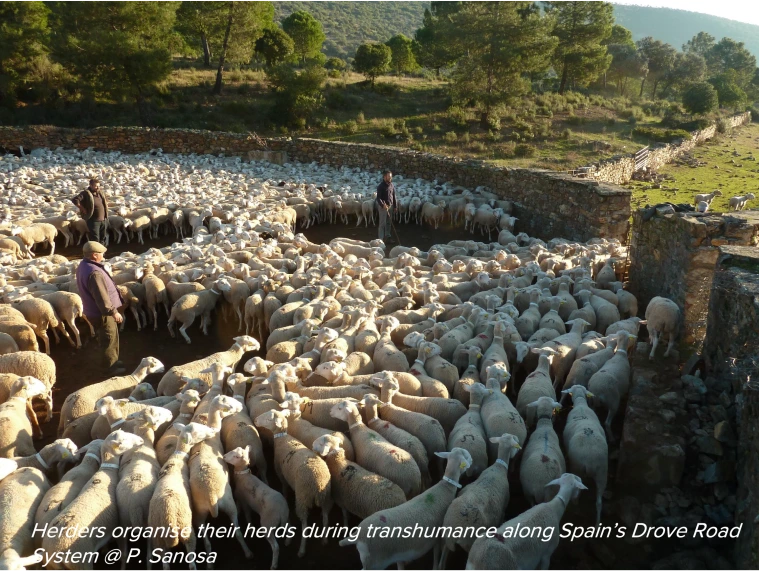
Mark Moritz: Except when they went on the move, and so he said when they move from the winter pastures in the lowland, and they moved to the summer pastures in the mountains, and everybody moves and all the household gears lifted on the animals. That's the most exciting ritual of the Basseri pastoralists. You see that this was also demonstrated today in the IYRP sessions. There were a couple of examples of pastoralists celebrating the trans humans, the movement of livestock from one seasonal area to another, through, for example, the streets of Madrid. It is about moving too forward, but it's also so much more.
Tip Hudson: Yeah, a few weeks ago, Ikon Samuels made a definition of pastoralist, but I'm curious, how would you define a pastoralist? Because I very much have that connotation that this is a lifestyle, and it is the thing that defines the culture.
Mark Moritz: Here I'm going to draw from work for Maria Fernandez Jimenez. She wrote a number of papers about pastoralist, identity, looking at examples from Rangers in American West to Shepherds in Spain, to pastoralists she worked with in Mongolia. One of the things the way she describes it is that pastoralists have a commitment to raising animals in a particular place with other people, and they share that commitment to raising animals in a particular place with other people. It's place, its people, and the activity of raising livestock. The activity of raising livestock, and I describe it in other places as a 24/7 commitment. If you do something every day, and it shapes your life, that is also why you can compare ranchers in the American West with pastoralists in Africa, with pastoralists in Tibet. Personally, I have a very broad understanding of what pastoralists are and encompasses a wide range of people. But what they share is that they have a commitment to raising livestock, and of course, that commitment takes them on the move because they have to go where the grass is. Because of that raising livestock and being on the move, they can develop an attachment to place, and of course, they cannot do this alone, if you get sick or you need help, you need the help of others. It's also shared cultural commitment. I know a lot of people do not agree. They have a much more narrowed definition, but I personally have a very broad definition.
Tip Hudson: Yeah, now I think that works, and it's understandable. What are some of the challenges to mobility as we're defining a pastoralist? I can imagine there's lots of different kinds of them. We talked about one of them, which is a sociopolitical challenge, but there would be others. What are some of the ones that you're familiar with?
Mark Moritz: Yeah, for me, it's mostly insecurity, and this is what's the topic that we talked about earlier.
Tip Hudson: Yeah.
Mark Moritz: I worked in the far North region of Cameroon, which is just close to Borno state in Nigeria, and that was the origin there. Boko Haram was very active. At some point, pastoralists basically fled the area because of the terror caused by Boko Haram. They left high-quality rangelands behind. And when my colleague interviewed pastoralists that fled Nigeria, they talked about like a paradise for pastoralists. There was lots of space, very few farms. There was lots of forage. There was peace. They had nothing to worry about. Of course, this was before Boko Haram. That is the greatest threat in the area that I work with. In other parts of the world, it may be a conversion of rangelands to either development here in the United States or to farms in many parts of the world, or also renewable energy projects like solar power. The land conversion is one of the major issues as well.
Tip Hudson: We often speak of land fragmentation as a challenge to wildlife habitat, but at least to the United States, that almost never gets applied to being a challenge for livestock movements. But that absolutely would be a major one, especially if you can't just stick your herd on a semi and drive them 500 miles to the next forage source. If they're moving on foot, but the next hundred miles is full of crop farms, you don't have a lot of options.
Mark Moritz: No, and if you pass by the crop farms, there's a risk that your animals go stray into the fields, and they are an even bigger.
Tip Hudson: They don't take that well.
Mark Moritz: Now, that is often a cause for lots of conflicts. Fragmentation is a major issue.
Tip Hudson: Yeah.
Mark Moritz: It is indeed the same problem as for wildlife. In Cameroon and other parts of the world, we talk about trans humans corridors, which are similar to wildlife corridors. You need to be able to get from one space to another space.
Tip Hudson: One of the objectives of the International Year of Rangelands and Pastoralists is to draw attention to this and then potentially build support for some solutions to these problems for what are often marginalized peoples. We think of rangelands as being marginal lands, marginal in terms of production. Like there's nothing better that can be done with them. But they're actually quite productive and usually providing highly significant ecosystem goods and services that are called various things by various cultures. But what are some policy changes that can improve that situation for what is a fairly important lifestyle in important people?
Mark Moritz: I serve on a working group for the IYRP. It's the working group on land rights. It's an international group of volunteers we met, and we still meet regularly over Zoom, and one of the things we did last year was to create a policy brief, it's called Securing Land Rights for Pastoralists, and can be found on the IYRP website. We basically started from scratch and without any pre-accepted truths. We figured out what if indeed the key for sustainable and productive use of rangelands is mobility, and that use of lands and grazing rights are seasonal and non-exclusive. Then what would the action items be for governments? One of the things that we discussed is that pastoralists don't necessarily want to own land. They want access to resources on the land, and they don't want to be on that one particular piece of land all the time. They want to be able to move where the resources are, and, of course, they change seasonally. Access to resources is seasonal. It's shared, it's non-exclusive. In many ways, it's a radical way of thinking about rights to resources.
Tip Hudson: Yeah.
Mark Moritz: Of course, it's radical from a conventional legal perspective. But that's not entirely true, because one of the things that we did after we developed the policy brief with action items, asking governments to do certain things to protect mobility, to protect access to grazing lands, one of the things we did is we looked for examples of existing laws and statues that actually do protect the right to move from one seasonal grazing area to another, the right to trans humans, the right to seasonal use of grazing resources on public lands. We got examples from across the world, from Africa, from Mongolia, from India, from the US, from Argentina. Examples of how in modern law, pastoralists' rights to resources that it's seasonal, that is shared and non-exclusive, how those are protected. You want to give examples to governments of what can be done and how those radical ways of thinking about rights to resources can be implemented and protected in law. That paper is coming out, hopefully, later this year.
Tip Hudson: You touched on it there, but I just want to verify that I'm understanding correctly that access to places that have forage is what's meant by land and water security, where there's reliable access? Or is it broader than that?
Mark Moritz: What do you mean by broader dot that?
Tip Hudson: Yeah, how would you define land and water security?
Mark Moritz: Of course, now you're asking definition question. I'm terrible at that. The way I would describe it, it's not so much that they have full ownership, meaning that they have the right to sell it, the right to exclude others, but that when they need access to resources that they can access it. Again, I'm just going out on a limb here, I'm not too familiar with the American West. But public lands are key for many ranchers, so they don't own those lands, but they have leases on the land, and that allows them to raise their livestock. In Cameroon where I work, pastoralists use public or national lands. They do not own those lands, but they have a right to use those lands to graze their animals. That's the most important that they have a secure right to use the resources on public lands or use the water on public lands, not necessarily that they own it privately and can exclude others from it. That's what we meant by secure access.
Tip Hudson: That sounds like one of the Western terms for that type of use is sometimes called the use of rectory right, where you have the right to put it to beneficial use, but you don't own it, you can't sell it, and you don't have exclusive access to it. Except what's defined by, within the community of people that are determining how this piece of land and water is to be used.
Mark Moritz: Yes, that's exactly it. Used to right the resource or used to graze your animals, but you don't have the right to sell it or to exclude others. Those user rights are critical for survival and for production.
Tip Hudson: Along those lines, I grew up in the American South, and when I was a kid, we had a fear of crossing a barbed wire fence that was in the middle of nowhere. We just had this idea that if we stepped from our property into the next property, we'd probably get shot, even though there probably had not been a human on that fence line, since somebody was deer hunting out there 20 years ago. But this idea of exclusive ownership of land is, I think, not as common and is a more recent idea that comes from things like cropping, where if I'm growing corn here, it means you can't plant wheat on the same square foot. There's only so many things there's a finite number of things that can be done. But with livestock, it's quite a bit different. There are older systems of what I would call land tenure, like communal use. I don't remember how much we talked about it, if at all, a few years ago, but we did link to a paper that you had published on this concept of communal use and the term ideal free distribution. There's not time to go into that a whole lot right now, but I would like to better understand that. My guess is that most listeners to this podcast, who are mostly in the United States and so-called Westernized nations, probably have a negative connotation for common-pool grazing resources. When we hear that, we think of the tragedy of the commons. I've read some of the rebuttals of the original stuff that got written about that by, I think, Garrett Hardin many years ago. But if you had two minutes to explain this concept of common pool resources and ideal free distribution, which I think makes sense of how that could work in the real world, how would you explain that?
Mark Moritz: Yeah, I would do it without making any reference to the concept without naming it. Like it's for the mat. We just earlier talked about how movement is critical, and movement is what allows for a sustainable pastoral system, and for resilient pastoral system, and for a sustainable use of rangelands. Fences are, of course, are antithetical to that idea of movement. In many ways, fences do not make sense in terms of highly variable systems where the distribution of resources changes over time. In the area we were working Cameroon, I used to work in the lagoon flood plain, you had thousands and thousands of pastoralists with about 100,000 animals or more. They would come at the end of the rainy season, they move into the flood plain because there was a green grass and lots of grass, and high-quality pasture. Pastoralists would come from Chad, they would come from Niger, they would come from Nigeria, they would come from Cameroon, and they were from different groups. Some of them Arabs, some are Fulani, and who he shall not be named would predict that that would lead to problems overgrazing and rangeland degradation. Elinor Ostrom, who was one of my academic heroes, would argue something similar, saying that, no, you need collective management, you need clear boundaries, and you need a well-defined group to protect these rangelands. Hardin argued for private ownership or paid state ownership, Ostrom argued, no it can also be managed as a commons. What I found is that and both argued that open access will lead to a tragedy, of course. Now I've used the word. But what I found is that in open access, that's not the case. The key is that it's self organizing, complex adaptive system. What that means that individual pastoralists make decisions about where to go and where not to go, based on the condition of their animals, the condition of the animals of others, and the variation in condition of the rangelands. Since they're free to move, and since everybody's free to move and everybody makes independent decisions about what's best for their animals. The end result is an ideal free distribution. What that means is that the grazing pressure matches the distribution of the resources. That's an emergent property that we found from the freedom to move. That's an outcome that's best for all. Of course, with fences, you would have the opposite effect. We run agent-based simulations where we do a sedentary model, say, a fenced-in model, and an open-access model. The open access model always is better in terms of productivity as well as sustainability. The fences model works, but you can only keep two cows versus 100 cows because you're stuck in one place.
Tip Hudson: But as soon as I asked the question, it immediately occurred to me the way the question is asked seems to immediately present a fallacy that there's a problem we call the commons a tragedy. Therefore, what's not common must be okay, but there's certainly plenty of tragedies that occur in closed, exclusive right systems. We see that I think less commonly today, but certainly, at the time that Hardin was writing, there were plenty of examples of tragedies of overgrazing in places where the animals could not move because they're fenced in, and the humans would overstock.
Mark Moritz: I think what you mentioned earlier it's a relatively recent innovation fencing. Private ownership of rangelands is also relatively recent innovation. Pastoralists have been around for millennia. That's one line of evidence that it's a sustainable system. Most likely, it was a form of open access because both private ownership as well as collective management in the commons takes a lot of work in terms of institutional cost, open access, because it's a self-organizing system, doesn't require a lot of political work or collective organization or collective action. One of the arguments that I have been making is that, in general, open access is the default. It's only when there's lots of pressure, and there's diminishing resources, that people start to fight over the resources.
Tip Hudson: I have lots more questions, but I think we're going to stop there. Mark, thank you very much for your time.
Mark Moritz: Yeah. My pleasure.
Tip Hudson: Thank you for listening to the Art of Range podcast. Links to websites or documents mentioned in each episode are available at artofrange.com. Be sure to subscribe to the show through Apple Podcast, Podbean, Spotify, and Stitcher, or your favorite podcasting app, so that each new episode will automatically show up in your podcast feed. Just search for Art of Range. If you are not a social media addict, don't start now. If you are, please like or otherwise follow the Art of Range on Facebook, LinkedIn, and X, formerly Twitter. We value listener feedback. If you have questions or comments for us to address in a future episode or just want to let me know you're listening, send an email to show@artofrange.com. For more direct communication from me, sign up for a regular email from the podcast on the homepage at artofrange.com. This podcast is produced by CAHNRS Communications in the College of Agricultural, Human and Natural Resource Sciences at Washington State University. The project is supported by the University of Arizona and funded by sponsors. If you're interested in being a sponsor, send an email to show@artofrange.com.
Speaker 1: The views, thoughts, and opinions expressed by guests of this podcast are their own and does not imply Washington State University's endorsement.