

Why are rangelands and pastoralists vital to the culture, ecology, and economy of the world? Igshaan Samuels, a rangeland scientist in South Africa and co-chair of the IYRP Global Alliance, defines and describes these people and places. You will learn in this interview that pastoralists are the front-line custodians of over half of the world's land area! The International Year of Rangelands and Pastoralists (2026) aims to raise awareness of these lifeways, the oldest in human civilization.
Transcript
Tip Hudson: [MUSIC] Welcome to the Art of Range, a podcast focused on Rangelands and the people who manage them. I'm your host, Tip Hudson, Range and livestock specialist with Washington State University Extension. The goal of this podcast is education and conservation through conversation. Find us online at artofrange.com.
Tip Hudson: Welcome back to the Art of Range. This is the first in a special episode series on the International Year of Rangelands and Pastoralists. These will be short interviews on a variety of themes that will connect listeners to other short films and Rangelands promotion opportunities throughout the year 2026. The January theme is a global overview of Rangelands and Pastoralists. These are words that many people would have difficulty defining. Even those of us who work in the social sphere of rangelands might have been a little unsure how to define a pastoralist when we first heard of this international effort. My guest today is Igshaan Samuels, who is a range scientist with the Agricultural Research Council in South Africa, and he's the global co-chair for the United Nations International Year effort. Igshaan welcome.
Igshaan Samuels: Thank you very much, and thanks for having me.
Tip Hudson: You're talking to us from Cape Town. Give us just a very brief background on how you came to be in the world of rangelands and what it is you do with the AgResearch Council in Cape Town.
Igshaan Samuels: Thank you so much. I fell in love with range science when I was doing my postgraduate studies. When I first visited the pastoral areas in the arid zones of Africa. I just fell in love with the landscape and the people, and it's an opportunity for me to work with both people and with the natural environment. That sparked a lot of interest in me. Then I started to get employed by the Agricultural Research Council, advanced my career through them, working in the arid zone, working with pastoralist communities. Then I got associated with the International Year of Rangelands and Pastoralist, first through the Eastern and Southern African regional group of the International Year, and then I was managing the policy working group for our region. From there onwards, I got the position of global co-chair of the International Year of Rangelands and Pastoralists Global Alliance.
Tip Hudson: Excellent. Well, let's just jump into it. Even in the United States, we have had several official definitions of the term Rangelands over the last century. How would you define? We're trying to look at Rangelands from a global perspective. We might think of sagebrush Rangelands or short grass prairie, and even in the United States, we have numerous plant community types that we would call Rangelands. How are you defining rangelands, or how are we defining rangelands for the international year?
Igshaan Samuels: Rangelands are defined by the International year as natural and semi-natural landscapes that are dominated by grasses, shrubs, herbs, or sparse trees, where the livestock or wildlife can primarily feed on. This vegetation, it includes not only grasslands, as many people think that rangelands and grasslands can be used interchangeably. Grasslands is just one ecosystem that's sort of part of the overall term of rangeland but rangelands can also include savannas, woodlands. Steppe, for example, in Asia, the deserts, for example, in North Africa, Tundra, and even wetlands and many other ecosystems can be classified as rangelands, these are all natural ecosystems, so we are not talking about cultivated crops. That is in a nutshell, the definition that the International Year is going with.
Tip Hudson: Yes, I like that. It's interesting that we sometimes think of rangelands or people that are not involved in rangelands have sometimes called them wastelands, meaning that they are places where nothing else has happened there yet. In fact, even in the way that we make maps, you oftentimes see different rangeland areas as gray scale or gray cross hatch patterns on a world map as if there's not much there to speak of, in fact, we use funny terms like this place is a biological desert. When people say that, they usually mean there's not much there. But of course, rangelands and even places that we would call we classify as deserts often have very high biodiversity, oftentimes, much higher biodiversity than the places on the map that have colors. Can you say a little bit more about the diversity and the ecological value of rangelands?
Igshaan Samuels: Certainly, recent estimates show that 54% of the terrestrial surface of the world has got some form of rangelands. If you look at it at that scale at planetary scale, it should, in essence, provide us with a lot of ecological services. Rangelands are the areas where there's a lot of biodiversity. I'm making an example in South Africa, which is one of the top five, most biodiverse countries in the world. It's 75% rangelands in South Africa and South Africa's about 23,000, almost 23,000 plant species, and most of it on rangelands. From an ecological point of view, this is where you find your diversity, your plant diversity. Obviously, plant diversity gives habitat to the fauna that are associated with rangelands are the storage areas for carbon, particularly grasslands, where the carbon is stored under the ground in the soil, which is much more stable. Rangelands are areas where the water catchments where water is being regulated by rangelands so that you can't have outside the water is being released slowly, especially through wetland ecosystems. Wastelands. Yes, there are few countries that still associate rangelands with wastelands or open or neglected spaces, but they are not. The deserts, for example, on the western side of Southern Africa is one of the arid biodiversity hotspots with close to almost 5,000 plant species present in a small environment. Large rangelands are not wastelands. It's not empty spaces, they are being used by people and you are very much crucial to the survival of humanity, if I should put it like that.
Tip Hudson: One of the objectives of the International Year of Rangelands and Pastoralists is to give more attention to these neglected spaces, as you call them. But maybe more importantly, the people of Rangelands are neglected peoples and sometimes even defined that way. What is a pastoralist?
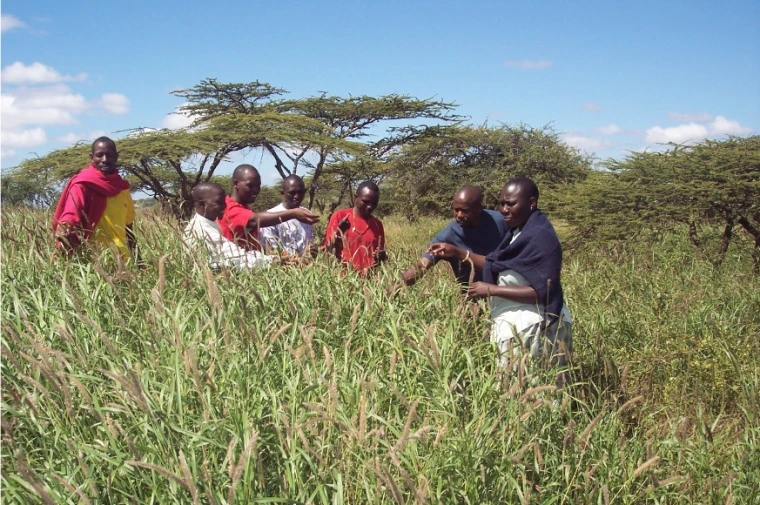
Igshaan Samuels: Pastoralism is quite, if you look at it as a system, it's quite diverse and dynamic. Defining a pastoralist is always sometimes contentious, or whatever definition that you come up with doesn't capture the range, the suite of various pastoralists. But pastoralists have a lot of aspects, a lot of attributes that they have in common. Key to pastoralism is mobility. Rangelands are variable, by and large, variable ecosystems where cropping can't thrive because either rainfall is too low or rainfall is too variable. Rangelands by and large, are variable systems, and you need mobility, we need people and animals to be mobile to access the heterogeneity, to move when there is climate hazards such as droughts or flood or sand and dust storms that you can move your animals to a better place. Key to pastoralists is mobility. You need to be mobile. Some pastoralists move over hundreds of kilometers across different nation states. Some move at smaller spatial scales and some move over months while others move over days. In essence, mobility, spatial and temporal mobility is very important. Another key aspect of the lifestyle of pastoralists is that they can keep a diversity of animals. It's not only about cattle or camels, or goats and sheep, but they also keep yaks, for example, on the Asian islands, the reindeer of the Arctic, the bison in North America, the vacunas and the llamas in South America. They keep a diversity of animals. These animals are adapted to the ecological aspects of the rangelands, and then also they occupy areas that are sometimes, very remote. It could be the drylands, the deep into the deserts of the Sahara, for example, or high on top of the mountains where they move down during the winter because it's too cold. There are a lot of attributes that pastoralists have in common. This could be, for example, the Maasai in East Africa, the Tuaregs of the Sahara or the Mongolian herders, the reindeer, the Sami reindeer herders, or the and the cowboys, for example, in North America, they get often under a description of being a pastoralist. But obviously, what did all these groups that I've mentioned, there are aspects of them. Few of them that might not fit the description of our pastoralists. For example, a lot of pastoralists lost their ability to move over large spatial scales or just to move in general, or quite a few of them lost their ability to practice what they are supposed to do in terms of managing risk and so forth. Some might have lost their animals. Some might have adopted a much more sedentary lifestyle and so forth. Even though so you can see, it's quite difficult to define what the pastoralist is, but there are a lot of commonalities that there are entrenched within pastoralism.
Tip Hudson: Very good. Listeners can go to iyrp.info to see some very well done films about Pastoralists and Rangelands around the world and follow related news. Also take a look at the links that we'll have in the show notes to see how you can share all of this with friends and family and colleagues who may still think rangelands are the empty space between cities. Igshaan, thank you.
Igshaan Samuels: Thank you.
Tip Hudson: Thank you for listening to the Art of Range podcast. Links to websites or documents mentioned in each episode are available at artofrange.com. Be sure to subscribe to the show through Apple podcasts, Podbean, Spotify, Stitcher, or your favorite podcasting app so that each new episode will automatically show up in your podcast feed. Just search for Art of Range. If you are not a social media addict, don't start now. If you are, please like or otherwise follow the Art of Range on Facebook, LinkedIn and X formally Twitter. We value listener feedback. If you have questions or comments for us to address in a future episode or just want to let me know you're listening, send an email to show@artofrange.com. For more direct communication from me, sign up for a regular email from the podcast on the homepage @artofrange.com. This podcast is produced by CAHNRS Communications in the College of Agricultural Human and Natural Resource Sciences at Washington State University. The project is supported by the University of Arizona and funded by sponsors. If you're interested in being a sponsor, send an email to show@artofrange.com. The views, thoughts and opinions expressed by guests of this podcast are their own and does not imply Washington State University's endorsement.
Visit the IYRP website at https://iyrp.info/ to experience pastoralists caring for rangelands and to learn how to share these important people and places with the people you interact with every day.
Be sure to watch the January IYRP video, a global perspective on rangelands, at https://www.youtube.com/watch?v=pSabIiO5Ps8